Showing posts with label University of Alberta. Show all posts

Tuesday, October 01, 2019

Both sides now (Musings on humans vs technology in transfusion medicine)

Stay tuned: Revisions are sure to occur

INTRODUCTION
There's much transfusion news these days on artificial intelligence (AI), big data, drones, innovations, new technology, precision medicine. In a way this blog is a follow-up to the prior one, 'Get back' (Musings on transfusion medicine's future).

September's blog (albeit published Oct. 1) was stimulated by a weekly feature ('Workplace column') on a local radio program I heard this morning (Further Reading). Also, because as an oldster I want a record of events I've experienced in the hope they will resonate with some and influence others to do similar. Otherwise when we oldsters croak, they're gone forever.

The blog's title derives from a song by Canada's Joni Mitchell.

As you read the blog, regardless of your health profession, please consider the challenges you faced if you have held a management position and, if not, think about the strengths and weaknesses of managers you have had. Also, consider the impact you as a manager have had on colleagues and the influence your managers have had on you and your career. 

Specifically, the radio column was on moving into management, generally viewed as a promotion with a higher salary. The columnist (@sandbaryeg) gave tips on becoming a manager for the first time. Her tips made me recall when I took a giant leap from a long career as a transfusion educator of medical laboratory technologists/biomedical scientists to become a lab manager at CBS ('assman' as the centre's QA department addressed my mail). True, I'd been lab supervisor in my 13-yr job before teaching, but with none of the responsibility the 'assman' position entailed.

Indeed, as I only learned later, although I managed the patient services lab at the blood centre, the position had been downgraded to 'assistant manager' in order for the centre (and perhaps head office?) to retain more control, especially over salaries. Also, I hadn't realized (bit stunned of me) that the person who had been an assistant to the prior manager and perhaps (just a guess) had applied for the job I was recruited for, and was the acting manager when I came. She was a prior student of mine, in fact in the first Med Lab Sci class that I taught all the way through, who I was and still am exceedingly fond and proud of.

My take on the consultant's 5 tips for new managers. How to
1. Run meetings, something many dread;
2. Give effective feedback;
3. Foster a team environment;
4. Attract & recruit the staff you need vs filling an existing job;
5. Manage your own time effectively.

Promotion: First, I'll note that in my experience (historical, I know, dating from 1960s-2000) often the folks who get promoted in the lab are ace technologists. If all factors are considered more or less equal, seniority may play a role. To me, that's not an effective process, but it's likely the easiest.

How often do fabulous footie players (soccer in NA) or hockey players become great managers? Not many. Why? Because the skills needed are quite different.

Needed skills? More recently, not only med lab techs/scientists but also physicians (perhaps nurses?) tend to get Masters of Business Administration (MBAs) as lab medicine and transfusion have become more and more a business. Presumably these degrees help in a new career as a 'suit' whose prime concern is the bottom line, though patient safety is always touted, given first place in communications.

I'll discuss the 5 tips in various ways based on my experience.

RUNNING MEETINGS
Decades ago as an educator I'd experienced many ineffective meetings, including those run by MDs at the departmental (Lab Med & Path) & Faculty of Medicine levels. Some dept. meetings were info-only unneeded sessions. Few required active participation. And often the minutes were totally useless to anyone not attending.
  • My experiences motivated me to write a resource for TraQ in 2009 on running meetings (Meetings as Time Wasters, Further Reading).
On running meetings in my brief career as 'assman' I was fortunate and smart to designate my prior student to run many meetings. She was experienced in the task and did it much better than I ever could. Only time I ran meetings was when it came to getting staff on board with changing almost all pretransfusion testing methods in the lab. That came easy as it was right up my alley as an educator.

In a similar vein, I was glad I'd insisted on a whiteboard for my 'assman' office as it was well used when meeting with supervisors in the various sections of the patient services lab.

EFFECTIVE FEEDBACK
As an educator I had to give feedback over decades and some was difficult. For example, telling foreign students (English as a second language), whose parents had struggled and worked hard to send them to Canada that they were not going to pass their clinical rotation. For such students it was a total disaster, an incredible loss of face and shame. Frankly, it broke my heart and I know that whatever I said to lesson the blow (e.g., they could have great success in another career) wasn't heard and didn't lesson their reality in any way.

In giving more routine feedback, as a med lab technologist with an MEd, I knew the characteristics of effective feedback. On a personal level I believe that often what shapes us for good and bad in life are 15-60 second interactions with others. For example, I'll never forget the powerful effect of my Dad saying, 'Pat, don't be afraid to be different.'

As a teacher of med lab students I always kept that in mind when giving feedback. Meant I treated struggling students the same as high achievers. And in retrospect I see that many of those who struggled have gone on to be high achievers, leaders in their field. Why? Suspect it's because success depends on many factors, not necessarily getting the highest grades.

A good pal is a standardized patient at the University of Alberta and they have a particular take on feedback, called CORBS (Further Reading):

CLEAR – Give information clearly and concisely
OWNED – Offer feedback as your perception, not the ultimate truth. Talk about how something made you feel. Use terms such as “I find” or “I felt” and not “You are”
REGULAR – Feedback is offered immediately, or as soon as possible after the event
BALANCED – Offer a reasonable balance of negative and positive feedback. DO NOT overload with negative feedback.
SPECIFIC – Feedback should be based on observable behavior and behaviors that can be modified.

TEAM ENVIRONMENT
Not much to say. Health care teams are similar to politicians kissing babies. Everybody does it as it's the reigning orthodoxy, the cliché of how we love to see ourselves. Again, University of Alberta has a course on it. INT D410 - Interprofessional Health Team Development.

Like to think I've been a member of many teams in health care (my transfusion families over the years) but must admit that many who promote it most publicly do not walk the talk.

RECRUITING STAFF
Will only speak to my recruitment to be 'assman' 21 years ago. Fact was the job was not quite as advertised. In retrospect I thought they portrayed part of the job almost as if it was what became hospital liaison specialists. I totally dug the part about the centre being the pilot site for a new information system and found it a worthwhile challenge.Our talented team of med lab professionals did a wonderful job in implementing the new IS.

Similarly, I loved the opportunity to change outdated lab methods, though don't think they hired me for that. It was just my 'value added' to the job I held for all of 9 months. When I tendered resignation I explained why in exit interview. They understood more money wouldn't make a difference and admitted they could not change what I thought needed changing most (head office, though it's more complicated than that).

So did CBS recruit the right person for the job? Yes and no. Yes, because I led the talented patient services lab team successfully through a difficult time of incredible change. No, because after years in academia at a university where dissent and free speech are cherished, I didn't fit in a national organization where adhering to head office directives was paramount. That's what made you a valued team member.

MANAGE YOUR TIME
The radio consultant pointed out that managers need to prioritize their tasks and serve as role models for staff as they cannot work to 10 pm over the long term. I don't have much to say except that you obviously cannot help others if you're exhausted. See it as a Buddhist concept that you need to love yourself, be okay with who you are, in order to love and help others. Over my entire career I was often the first in and last out daily but that's another story.

CONCLUSION
Are AI, big data,new technology, precision medicine all important to health care and more crucial than the qualities of people in leadership positions? Perhaps. But not to me. As a human being on plant earth, I'll always value the human condition over technology. See excerpt from 2001, a Space Odyssey (Further Reading).😁

FOR FUN
Chose this song because I've lived long enough to see transfusion medicine evolve from being people-focused to technology-focused. As  early adopter of technology (not a Luddite), I doubt we're on the right track (Further Reading). Also, admit that I love the songs of Canada's Joni Mitchell.
FURTHER READING


Saturday, July 22, 2017

Both sides now (Musings on where careers take us)

Updated: 2 August 2017

July's blog originated when, after decades of hoarding 'stuff', I finally decided to clean out a file cabinet. In the Medical Laboratory Science (MLS) folder, where I'd taught for 22 years+, I came across a graduation talk I'd given in 1991. The talk got me thinking about preserving (via a blog) some of the history of med lab techs who got caught in the cost constraints of the 1990s and had to work outside Canada. Some eventually decided to transition to other careers. 

The idea for the blog further crystallized when a local radio station used as its 'talking point of the day' 
  • 'How did your education (or lack thereof) play into your career? Are you doing the job you trained for and can people still learn on the job?'
I thought the question's focus was slightly off because it assumed that education for a career was mainly for a particular profession's job-specific tasks and ignored all the transferable skills students learn with a good professional education.

Executive version: What follows is an edited version of the grad talk followed by my musings on what happened to the careers of some graduates in the 1991 class. My thesis is that, if education for a career is sound, graduates come out with the self-confidence and transferable skills to transition to wherever life takes them.

Why read it? The educational issues discussed relate to med lab techs/biomedical scientists everywhere and cover a few of the transferable skills essential to any health professional. As well, the blog may resonate with nurses and physicians who find themselves forced to travel to foreign lands for job opportunities. 

Today where I reside (Edmonton, Alberta, Canada), depending on which provincial political party wins the election in 2019, health professionals could find themselves back in the 1990s when medical laboratory technologist, nursing, and laboratory physician jobs all but dried dried up due to the government's obsession with balanced budgets. 

The blog's title derives from an iconic 1967 song written by Canada's Joni Mitchell. I used it once before for a 2013 blog.

GRADUATION TALK TO MLS CLASS of 1991
What follows is an edited version of the talk. It's a run-of-the-mill talk but makes a few points I think are key to a sound education and still apply 26 years later.
Thanks very much Terry for your generous introduction. I am glad to have this opportunity because there are a few things I still need to cover with this class. First, I thought we would have a spot quiz, because students love them. Be aware that some of the answers will only make sense to the graduates. Let’s begin, starting with a test of your long-term memory.
Q #1: How many 1st-year MLS students does it take to change a light bulb?
  • Five. One to change it and four to set up Kohler illumination.
Q #2: How many 2nd-year students does it take to change a light bulb?
  • None. At least not in my class. You see, they were all asleep during my Powerpoint presentations and the light would only have disturbed them.
Q #3: How many 3rd-year students does it take to change a light bulb? [3rd yr is the clinical rotation yr]
  • The whole class. One student to change it and the rest to complain that their friends in other faculties had all summer off to do it.
Q #4: This one is a test of your short term memory. How many 4th-year students does it take to change a light bulb?
  • Again, the whole class. One to change it and the rest to complain that it should be deleted from Path 401 [a catch-all course, long since dropped].
Q #5: How many MLS instructors does it take to change a light bulb?
  • Ten. One to change it and nine to evaluate whether it was done right.
Now that the spot quiz is over there are a few things that I would like to talk to you about in a more serious vein. 
A few weeks ago I went to the Ambassador Awards at the Convention Centre. It was attended by people from all walks of life who belonged to associations like the CSLT [now CSMLS] that can bring conventions to the city. The organizers gave out awards and asked all of us to act as ambassadors by promoting Edmonton as a convention site. 
The thought occurred to me that in one way or another we all act as ambassadors. For example, when we are tourists in a foreign country, or when we interact with visitors to our city. 
So I would like to talk tonight about the idea that all of you—the MLS graduates of 1991—are going to be ambassadors for MLS whether you realize it or not. No matter what the future holds for each of you, all of the people you will meet will be gaining impressions of MLS through you, your actions, and attitudes. 
Now before you say, “Good grief! I can’t handle the pressure—-MLSers for life”—I want to tell you that I have great faith in each and every one of you. As an MLS instructor I have been privileged to share a part of your life for the past few years. 
Let me explain why I think that you will be great ambassadors. In a way, I feel like the mosquito in a nudist colony. I don't know where to begin.  
First, there are all of the things you have learned while in MLS. And I’m not talking about the knowledge and technical skills you have assimilated, although these are important. You have learned so much that what you have forgotten would fill a library.No—I’m talking about transferable skills that you will find useful all your lives. 
For example, you have learned how to be good listeners. Goodness knows you have had enough practice being listeners during your time here. As you begin your careers, remember the words of a wise person who once said, “good listeners are not only popular everywhere, but after a while they know something.” I have learned much from listening to you over the years.
You have also learned how to communicate clearly, both orally and in writing. Who can ever forget their first teaching assignment? I should explain that our students give at least three oral presentations to classmates and instructors beginning with teaching assignments during 3rd year. 
I’m sure that some of you think that teaching assignments were cruel and unusual punishment—both for the student and the audience. But, boy, do they ever pay off. The progress you made was really shown when you presented your 4th-year research projects. Your instructors and supervisors were impressed. 
This ability for you to make presentations will be a real plus for you in any career. I tell you this because I have listened to many technologists, scientists, and doctors who have not had the advantage that teaching assignments provide—namely to express ideas clearly and concisely. And listening was brutal.
There are many other intellectual skills you have learned. For example:
  • Your grasp of the scientific method and all that entails; 
  • The ability to be skeptical about so-called established knowledge, and yet to be open-minded about complex issues;
  • You know that it is okay to say, “Gee, I  don’t know, but I will find out”;
  • Most important of all, you know how to learn
You will draw on these skills over and over again— especially because medical laboratory science is evolving so rapidly. 
I would like to shift for awhile to some of the ways you have all grown in your personal development. 
Those of you who entered MLS lacking self-confidence have seen your belief in your abilities increase. Self-confidence is essential because no one will believe in you if you don’t believe in yourself. I’m not talking about being over-confident and self-important, but rather about the quiet self-assurance of people who are competent and know it. 
Conversely, if you came with a fair degree of self-confidence—if you were like me at 18 (and trust me, I was 18 once—and thought I pretty much knew everything) —then your experiences in MLS have added to your growth by teaching you humility. 
Your entire 3rd year was an exercise in discovering your strengths and weaknesses, coming to terms with them, and accepting both praise and criticism gracefully. 
It was hard to be evaluated each and every day of your hospital rotation; it was hard to accept feedback that you may or may not have felt was justified. But you all did it, and because of this you will have a big advantage in the workplace, as well as in life.  
Having a positive approach to learning will always serve you well. You know that imperfection is only human. The important thing is that we all try to do better. And keep in mind that misery is optional. 
You have also learned what friendship means. In the years ahead, you will remember your friends very fondly . One definition of a friend is “a friend is one who dislikes the same people that you dislike.” There is a lot of truth in this, but a better way to think of friendship is to realize that the only way to have a friend is to be one. You have all done that during your university days. 
Let me remind you that universities have always stood for the dignity of each human being—for the belief that each individual is to be appreciated for what they uniquely think, do, and feel. I want you to realize that you are important and have had an impact on your friends and teachers in MLS. 
Earlier I said that, whether you realize it or not, you are going to be unofficial ambassadors for MLS. Over the years, you have seen many role models—instructors, professors, nurses, doctors, and technologists. As ambassadors-—-with personalities and styles of their own—they succeeded to varying degrees in creating good-will for their professions. Soon you too will have this responsibility. 
As you leave MLS, remember the people who have influenced you. Think of those who have treated you with dignity and patience, who smiled rather than frowned, who took the time to criticize constructively, who showed you how to solve problems as medical laboratory scientists, who loved their subject, and who challenged you to be your very best. 
These are the people you will want to emulate as you become role models for others. And now, graduates—this is your night. You have struggled and succeeded in a difficult program. We, your instructors, are very proud of you. You have chosen a rewarding and challenging career.  
In conclusion, it's a cliche but always believe in yourself. You are graduates of the most rigorous Medical Laboratory Science program in Canada and one of the best in the world.  And don't be afraid to dream of what you want in life. No matter what the future holds, you have the right stuff to succeed.
MUSINGS
Of the 22 students in the 1991 MLS graduating class, here's what I know 26 years later about their careers. Most, as would be expected, went on to have careers as medical lab technologists/scientists. But the 1990s brought severe healthcare cuts in Alberta and throughout Canada and jobs became scarce. Graduates' careers I'm aware of:
  • Went to NZ to work for New Zealand Blood Service (NZBS) - 2
  • Worked for CBS, Canada's national blood supplier for years - 2
  • Dentist - 1 
  • Lawyer - 1 (after years of working as a med lab tech in Canada and later for NZBS)
  • PhD (microbiology) - 1
  • Gynecologist -1 (who was in Christchurch, NZ on a fellowship learning advanced laparoscopic surgery when the earthquake struck in 2011)
  • Radiologist - 1 (after many years of working as a med lab tech in USA)
To me, this validates that graduates of MLS at the University of Alberta learned many transferable skills and had the self-confidence to believe in themselves and accept challenges, as well as to dream. As one example, the MLS grads who went to NZ to work for NZBS (six in all from several graduating classes) were brave indeed and went through all the government hoops and regulations, requiring incredible stamina and belief that they could do it, no matter what. 

ANECDOTE #1
I'll share correspondence I had with one grad (John) 8 years later (when he was 30 years old) and again, 14 years post-graduation. John, like most MLS grads, had written the USA's ASCP(MT) exams when he graduated from the University of Alberta MLS program. As a result, he could go to the USA under NAFTA with a BSc (MLS) and work in a profession that was deemed needed in the United States. He worked for years as a med lab tech in Montana and also acquired EMS certification and worked part time as a firefighter. 

He wrote me and 3 others in MLS in 1999 because he had obtained his green card and could apply to U.S. medical schools and needed references from his instructors.

Bottom line was that John was accepted into an American medical school in ND, interned in Spokane, Washington, and later got a residency at the coveted Mayo Clinic in 2005, followed by specializing in radiology.He also did a fellowship in Neuroradiology at the Mayo Clinic. 
Mayo Clinic info (1999):"The Mayo residency and fellowship programs are among the most sought-after in the world. Last year, nearly 7,000 people applied for slightly more than 360 positions....Last year, the medical school accepted only 42 new students and only about 5% of those who applied for a residency or a fellowship."
Going back to MLS, in the 3rd year, students rotate through the clinical laboratories in groups of 3 or 4. I distinctly recall John's group because they were so motivated and, more importantly, so much fun to teach. Honestly, everyone should be so lucky to have such students.

John rotated with two female students (Donna and Jennifer), who both went to to work for NZBS in Hamilton, NZ for several years. Jennifer eventually became a lawyer and now works for a law firm in Edmonton where she represents hospitals/health regions and their employees, including AHS . Donna, who prior to NZ had worked for years in a Las Vegas mega-lab where technologists were more like factory workers, later worked for CBS and now works in a local hospital laboratory.

My spouse and I visited NZ for 6 weeks in 1998-99 over Christmas/New Years and touched base with two of the MLS grads, including Donna, who had the courage to go to a foreign country to practice their profession. They had made the best of a bad situation and were loving their foreign adventure.

These grads believed in themselves and were great ambassadors for MLS at the University of Alberta.

ANECDOTE #2
While the MLS grads worked for NZBS, a US software company visited to demonstrate and pitch its blood bank software. Reason I know this is that the software company (Wyndgate Technologies, now Haemonetics Software Solutions) contacted me. 

Specifically, they wanted to know if MLS had more grads like the ones working at NZBS because they were very impressed with them and would love to hire some.

Bottom line: Two MLS grads were brave enough to transition to software testing and moved to Sacramento, California to work for Wyndgate in 2000. One worked for Wyndgate/Haemonetics for 15 years, latterly in a senior management position.

FOR FUN
I chose Joni Mitchell's 1967 song for two reasons. Of note, it has been covered ~600 times by other artists and counting. 

First, I love it. By any standard, Canada's Joni Mitchell is a songwriting genius.

Second, to me it means that life isn't always what you expect it to be. We win some, lose some in the careers we choose but in the end we're left with the illusion of what we hoped it would be. And that's okay providing we acquired the skills to follow our dreams past the illusion. Perhaps too philosophical?
I've looked at life from both sides now 
From win and lose and still somehow 
It's life's illusions I recall 
I really don't know life at all. 

As always, comments are most welcome.

Tuesday, December 11, 2012

Here Comes the Sun (Musings on putting fun back into transfusion medicine)

Updated: 28 Mar. 2021 (Fixed links)
This month, some light fair for December, Here Comes the Sun (Musings on putting fun back into transfusion medicine). The title comes from one of my favorite George Harrison songs.

The blog was stimulated by the Royal College of Pathologists of Australasia social media campaign to encourage viewers to imagine a "World Without Pathologists." Gee, I often dreamed of that when working in the transfusion service lab and later, when teaching. Just kidding, sort of.

THE FUN STUFF 
 Some videos that I hope will tickle your funny bone. 
First, take-offs on 'Call Me Maybe' by Canadian Carly Rae Jepsen, which is up for a 2013 Grammy as Song of the Year.
Non-health versions:  Many health professionals use XtraNormal to produce fun videos that highlight the in-jokes of inter-professional relationships. Examples:
Medical schools have a tradition of producing humorous videos. One that I particularly enjoy is by University of Alberta med students:
Very funny, give it a chance. Part 2 has its moments too.

Hope you get a few chuckles from these inside jokes. If you know of similar videos, please let me know. 

FOR FUN
The blog's title comes from one of my favorite Beatle ditties. I live in Edmonton, the northernmost city in North America but we are one of Canada's sunniest cities, getting more than 17 hrs. of sun per day at summer solstice. 
And just because this clever remix with Rita Hayworth dancing in 10 of her movies is fabulous:
If this doesn't make you feel good, you're not alive. Also enjoy original with John Travolta strutting his stuff:
Comments are most welcome and can be anonymous or under your name.

Merry Christmas, Happy Chanukkah, Happy Holidays to all.

Tuesday, October 09, 2012

The long and winding road - good vibrations (Musings on preparing for career advancement)

This month, I'm pleased to have a guest blogger, one of my 'kids' (former students, MLS grads, all of whom I'm extremely proud of):
  • Lisa Denesiuk, MLT, ART (CSMLS), MLS (ASCP), SBB (ASCP), BSc (MLS)
Earlier this year Lisa moved to a new position with Dynalife Dx and became a Learning Management System and Website Content Specialist. 

Intrigued by her job title, I asked Lisa to write a guest blog on how that came about and what was involved. Despite being a busy health professional, she graciously agreed.

The blog's title comes from an old Beatles song (naturally) and a classic by the Beach Boys. 

Why should you read this blog?
To me, Lisa's career path epitomizes a Louis Pasteur quotation:

  • Chance favors the prepared mind.
  • If you retain nothing more from this blog, remember this.
Educators like to tell students that their undergraduate degrees can take them in many directions. To me, careers beyond the routine are possible only if graduates actively continue to learn both formally and informally, and that takes much effort. 

Continuing education (CE) and continuing professional development (CPD) require commitment to learn outside of work hours, invariably sacrificing time with family and friends or relaxation time. Often it also involves spending one's own money, since today's employers seldom offer financial support to take courses or attend conferences, even if staff present at them.

Going to work each day and giving 100% is not enough. To prepare for future job opportunities, health professionals need to give blood, sweat and tears after hours.

For those of you who want to advance, who want to do something different, yet still use your basic health profession education and training, below is one person's path to an interesting career.

Advice from me to you: Instead of reading the way that busy health professionals usually do (i.e., rapidly scanning and racing through e-mails and websites without content registering in your mind), I suggest you sit back, take a few deep breaths, and focus on slow reading. If you don’t have the time right now, return to the blog when you do.

Slow reading is analogous to slow cooking, an alternative to fast food and something I now practice daily. Reading much transfusion-related news to decide if it’s worth reporting, I’ve had to institute the practice of slow reading. Try it, you’ll like it!

BACKGROUND
As background, Lisa is one of two former students who were awarded the ACMLT Award of Distinction.

Because she began work in a transfusion service, I followed Lisa's career with interest, as I do all MLS grads, especially those who are employed in transfusion laboratories or blood centres.

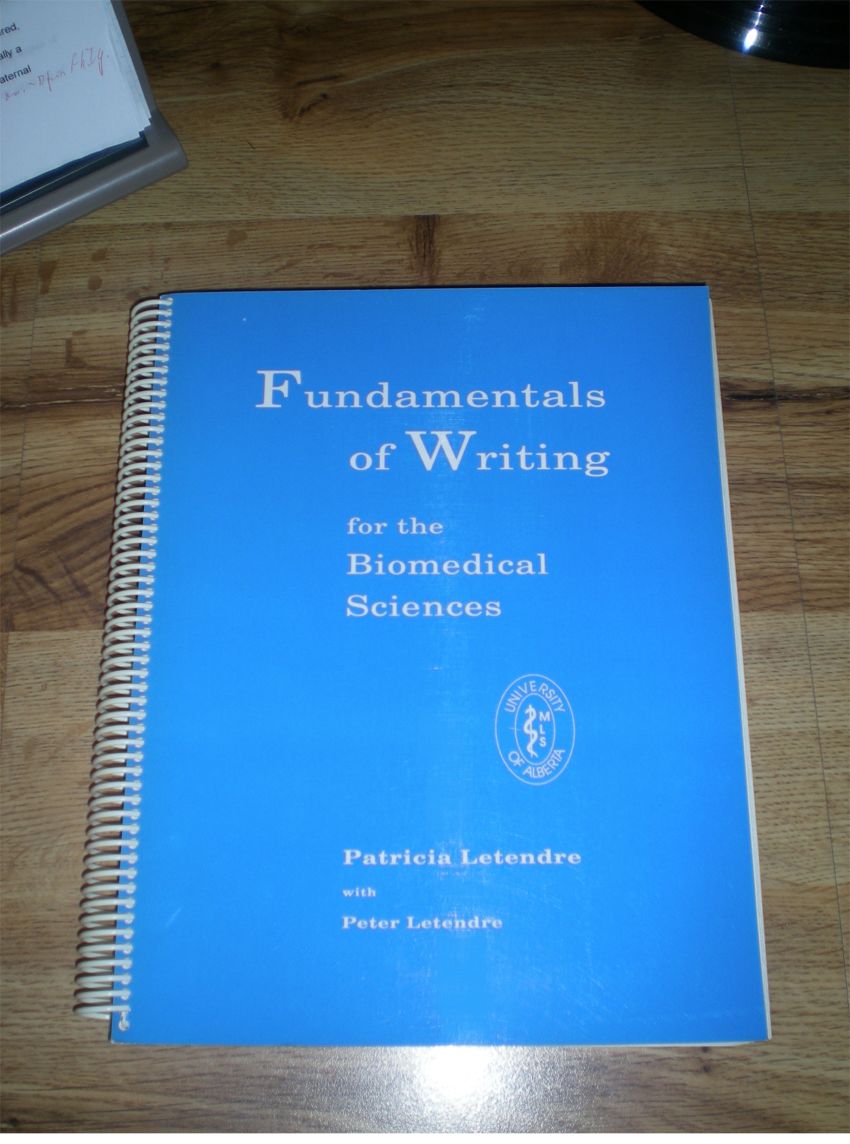
As well, Lisa took a CE course I offered by distance education on scientific writing. The CE course was based on a book written as a supplement to MLSCI 320, Fundamentals of Writing for the Biomedical Sciences, later translated into Japanese, as Wakariyasui igakueigoronbun.

Of 100s of participants, Lisa achieved the highest grade. Since this was pre-Internet, the course was an old-fashioned, paper-based correspondence course.

Anyone who has evaluated written papers, essays, and the like, knows that grading them is sheer hell. Which is my way of saying that marking Lisa's assignments was pure pleasure, forever endearing her to me. 

What follows is Lisa's story from bench lab technologist to Learning Management System and Website Content Specialist. Regardless of your current professional role, her narrative has lessons for all.
`````````````````````````````````````
GUEST BLOG  by Lisa Denesiuk

How did I get here?
It was a long and winding road (Pat will insert appropriate musical link - see later), which is ironic (ditto on an old Alanis Morissette song) because one of the reasons that I chose the medical laboratory profession was that I liked the straight line from finish this program to get this job.

Straight Path
I started out on that straight path, graduating from the University of Alberta Medical Laboratory Science program in 1987 and working (with a few minor detours) for 13 years on the bench in the transfusion service of a busy, inner city hospital.

Twists in the Road
My next job involved moving off the bench and off shift work. I assisted rural transfusion services with maintaining competency and updating procedures and implementing new processes (such as a redistribution program for near-outdate group O RBC). I was a consultant but under the auspices of my employer’s contracts rather than on my own.

Then the off-the-bench road developed more switchbacks.  Another round of healthcare restructuring meant that there was not enough transfusion medicine within my employer’s portfolio to support a full time transfusion specialist.

I had to choose between switching employers and switching career focus.

Fork in the Road
Choosing to stay with my employer, I moved into departments and jobs with difficult to explain titles like ‘Strategic Initiatives’ and ‘Business and Technology Analyst’. 

The beauty and the horror of the coordinator/ analyst/ specialist/ consultant jobs were that I was never quite sure what I would be doing next.  Obviously horrific for someone who likes straight lines, but really beautiful for someone who likes to learn new things.

On a personal scale, my career choices allowed me to develop some advanced software skills (I am still one of the go-to people in my company for advice on making Excel® charts with three axes, though I could never get the hang of pivot tables). I also learned and re-learnt a lot about the non-transfusion laboratory disciplines.

And most importantly, I had to maintain the knack for learning new things quickly (assuming I wanted to stay employed, pay off my mortgage, and continue to supply my cats with organic cat food, which of course is non-negotiable). Which leads to my latest job...

And where is ‘here’?
My new job title is Learning Management System and Website Content Specialist. The font on both the paper and electronic business cards keeps getting smaller and smaller.
The back story. . .
  • My employer bought a learning management system (LMS-software to track learning) and learning content software (LCMS- to build eLearning courses) about 2 years ago.
  • Originally, consultants built our first few courses based on information provided by supervisory and experienced staff members.
  • It took about 1 year to get everything ready for a launch to employees. Then. . .
  • About 2 months before the date set for the launch, the employee in charge of the LMS transferred to another department.
  •   At that time, the organization decided to bring the course building in-house. So the ‘team’ was reorganized into one ‘content specialist’ (i.e., laboratory geek) and one ‘developer’ (i.e., IT geek). I’m the lab geek.
Needless to say with both of the team members having < 2 months to learn the LMS themselves before explaining it to 1100 employees (> 500 in one-on-one sessions), our first few months on the job were hectic!

Why was I the ‘chosen one’?
  •   Served on the committee that investigated eLearning providers and suspect that the questions asked during this process demonstrated an understanding of life-long learning and a passion for the topic. (Likely the main reason the position was offered.)
  • Gained much informal teaching experience in my laboratory career, but current boss was probably unaware of most of it.
  • Discovered early that I loved to teach and succeeded at it. Almost from the moment my probationary period ended, I was a preceptor while on the bench.
  • While a TM consultant, I often gave review sessions to staff in the rural hospitals and presented at conferences.
  • Participated in continued professional development in various formats over the years, but again current boss probably didn’t know about that. 
A self-confessed CE junkie, I’ve added several letters behind my e-signature:
SBB blended program (2 weeks on-site within a full year course of distance education) from the University of Texas Medical Branch.
Took instructor-led courses, paper-based distance courses, electronically delivered courses, blended courses, courses for fun, courses for work, courses for professional development ... name a course type and I have probably taken at least one example.
Also volunteered a lot for professional organizations, which is an amazing source of informal education. Plus you get to know the most incredible fellow laboratorians.
Unexpected Opportunity Knocks
You never know what unexpected opportunities will develop from something that seems straight forward. I finished the UTMB course, passed the ASCP SBB exam and went back to my life.
Then a couple years later I was asked to write the ABO chapter for a new transfusion textbook, because my SBB instructor recommended me to the book authors. I wrote the chapter and then a couple of years later was asked by the book authors if I would like to become the fourth co-author on the textbook because they were stuck and needed some change to kick start the project.
And several years later we are on the final push to meet our deadline so the first edition can hit the shelves in June 2013. And for the last few months I have been in charge of developing the figures. All of a sudden I can do intricate stuff in Visio® because years ago I took an SBB course, not an obvious outcome.
What does a content specialist do?
My core function is as interpreter. . . I’m the go-between for the subject matter experts (SMEs) and the developer. To illustrate, my position includes:
  • Listening to what the SMEs want.  Love this acronym. Doesn’t it conjure a picture of a scholastic smurf-like creature? I often have to hone their focus to something manageable.
  •  Investigating the topic, then building a storyboard (think PowerPoint® with notes about animations, pictures, pop up boxes, rollovers, etc.) and an exam question bank.
  • Facilitating the review by SMEs and, after tweaking, handing the storyboard over to our developer (IT geek) to build the eLearning course.
  • Helping if the developer doesn’t understand some laboratory-specific process or jargon or what my storyboard notes mean.
  • Coordinating the course rollout to appropriate staff members.
Concrete example:
  • SME’s manager: ‘We want to reduce our data entry errors.’
  • Me to the quality department: ‘What are the 3 most common data entry errors we see?’
  • Me to the SME: ‘Can I sit in on your 2-day in-person training session for newly hired laboratory assistants?’
  • Me to the IT geek: ‘Here is the first of 3 storyboards about data entry - it is all about entering patient demographics correctly.’
  • IT geek to me: ‘Do you really want to say Order a DPHON on this slide or is this some bizarre typo?’....Reply:  ‘Yes, that is a comment that our laboratory information system recognizes and it translates to …and the laboratory assistants will know what that sentence means.‘
  • Me to the LMS via writing an ongoing rule: ‘Enroll all laboratory assistant IIs who work in patient care centres in the first data entry module.’
What do I love about my job?
  • Getting to teach again
  • Opportunities that electronic learning presents
  • Great potential to help our staff members, who are geographically scattered
  • Learning or re-learning many different topics
  • Working with new technology and coming up with creative solutions to obstacles
What I don’t like about my job?
Unfortunately, I’m
  • Sad when hearing that staff members see eLearning as an imposition rather than a benefit.
  • Frustrated when the priorities we work on change after every meeting and consequently for months nothing ever seems to get to the finished product stage.
Most frustrations relate to being in the midst of a cultural change. Half the management and executive team seem to see eLearning as the magic pill that will cure all ills and the other half are not convinced that time, energy and money invested in the system will result in a good return on investment. 

I’m sure the reality will fall somewhere in the middle, but in the meantime, we are caught between widely divergent, and often unrealistic, expectations.

My own learning journey
Besides the obvious learning of new software systems and relearning of laboratory topics, my employer is supporting my pursuit of a Certificate in Adult and Continuing Education (CACE).

What if you wanted to become a learning content specialist?
  • Structured programs about building eLearning (IT geek part) and about delivering adult education (lab geek part) are expanding. Consider taking a few courses.
  • A content specialist requires strong communication skills as the bedrock, and experience is the best top soil. (What I bring that the consultant could not was credibility with the SMEs. Being able to talk the lab talk goes a long way to smoothing over differences of opinion). 
  • The mulch in the metaphor is being able to learn both lab topics and new software quickly.
  •  My best advice is to be open to opportunities, which often cloak themselves as ‘more work projects.’
FOR FUN
As noted, the blog's title derives from these songs
Comments are most welcome BUT, due to excessive spam,  please e-mail me personally or using the address in the newsletter notice. I’d love to hear how you prepare to advance and expand horizons beyond the typical career ladder.