Tuesday, October 09, 2012

The long and winding road - good vibrations (Musings on preparing for career advancement)

This month, I'm pleased to have a guest blogger, one of my 'kids' (former students, MLS grads, all of whom I'm extremely proud of):
  • Lisa Denesiuk, MLT, ART (CSMLS), MLS (ASCP), SBB (ASCP), BSc (MLS)
Earlier this year Lisa moved to a new position with Dynalife Dx and became a Learning Management System and Website Content Specialist. 

Intrigued by her job title, I asked Lisa to write a guest blog on how that came about and what was involved. Despite being a busy health professional, she graciously agreed.

The blog's title comes from an old Beatles song (naturally) and a classic by the Beach Boys. 

Why should you read this blog?
To me, Lisa's career path epitomizes a Louis Pasteur quotation:

  • Chance favors the prepared mind.
  • If you retain nothing more from this blog, remember this.
Educators like to tell students that their undergraduate degrees can take them in many directions. To me, careers beyond the routine are possible only if graduates actively continue to learn both formally and informally, and that takes much effort. 

Continuing education (CE) and continuing professional development (CPD) require commitment to learn outside of work hours, invariably sacrificing time with family and friends or relaxation time. Often it also involves spending one's own money, since today's employers seldom offer financial support to take courses or attend conferences, even if staff present at them.

Going to work each day and giving 100% is not enough. To prepare for future job opportunities, health professionals need to give blood, sweat and tears after hours.

For those of you who want to advance, who want to do something different, yet still use your basic health profession education and training, below is one person's path to an interesting career.

Advice from me to you: Instead of reading the way that busy health professionals usually do (i.e., rapidly scanning and racing through e-mails and websites without content registering in your mind), I suggest you sit back, take a few deep breaths, and focus on slow reading. If you don’t have the time right now, return to the blog when you do.

Slow reading is analogous to slow cooking, an alternative to fast food and something I now practice daily. Reading much transfusion-related news to decide if it’s worth reporting, I’ve had to institute the practice of slow reading. Try it, you’ll like it!

BACKGROUND
As background, Lisa is one of two former students who were awarded the ACMLT Award of Distinction.

Because she began work in a transfusion service, I followed Lisa's career with interest, as I do all MLS grads, especially those who are employed in transfusion laboratories or blood centres.

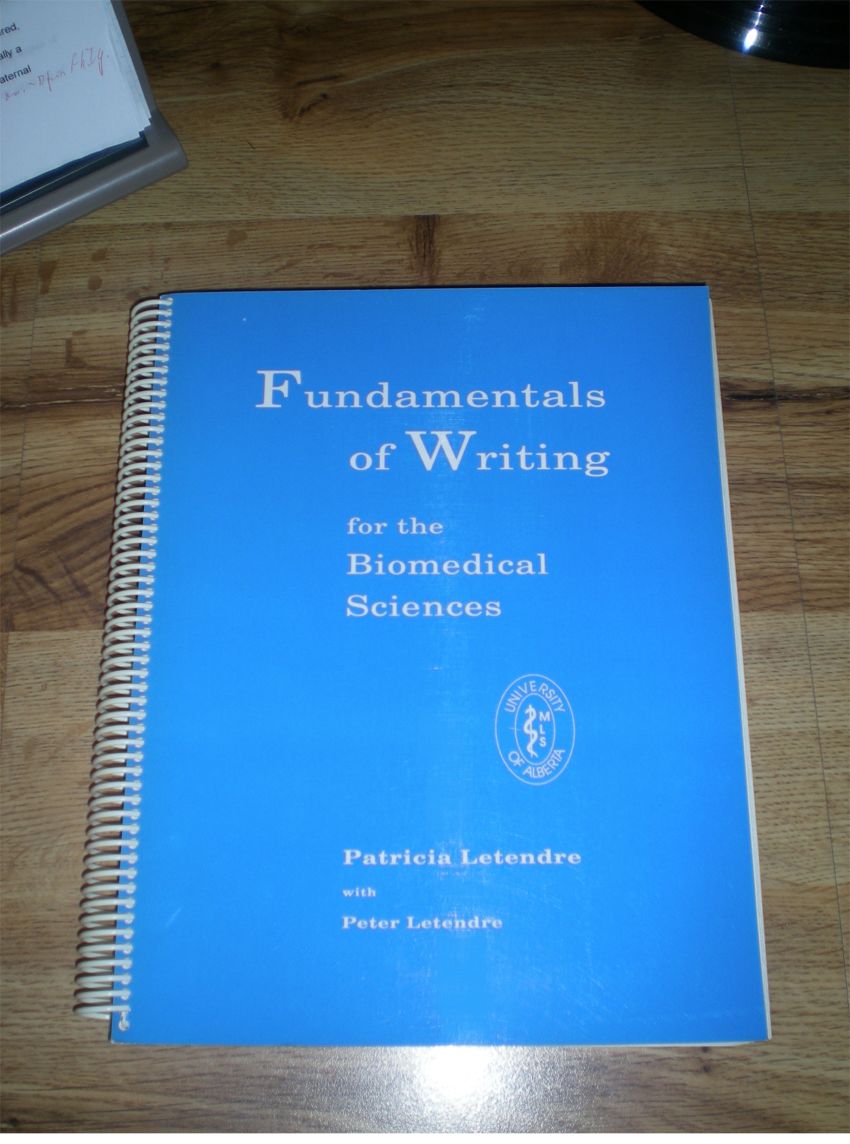
As well, Lisa took a CE course I offered by distance education on scientific writing. The CE course was based on a book written as a supplement to MLSCI 320, Fundamentals of Writing for the Biomedical Sciences, later translated into Japanese, as Wakariyasui igakueigoronbun.

Of 100s of participants, Lisa achieved the highest grade. Since this was pre-Internet, the course was an old-fashioned, paper-based correspondence course.

Anyone who has evaluated written papers, essays, and the like, knows that grading them is sheer hell. Which is my way of saying that marking Lisa's assignments was pure pleasure, forever endearing her to me. 

What follows is Lisa's story from bench lab technologist to Learning Management System and Website Content Specialist. Regardless of your current professional role, her narrative has lessons for all.
`````````````````````````````````````
GUEST BLOG  by Lisa Denesiuk

How did I get here?
It was a long and winding road (Pat will insert appropriate musical link - see later), which is ironic (ditto on an old Alanis Morissette song) because one of the reasons that I chose the medical laboratory profession was that I liked the straight line from finish this program to get this job.

Straight Path
I started out on that straight path, graduating from the University of Alberta Medical Laboratory Science program in 1987 and working (with a few minor detours) for 13 years on the bench in the transfusion service of a busy, inner city hospital.

Twists in the Road
My next job involved moving off the bench and off shift work. I assisted rural transfusion services with maintaining competency and updating procedures and implementing new processes (such as a redistribution program for near-outdate group O RBC). I was a consultant but under the auspices of my employer’s contracts rather than on my own.

Then the off-the-bench road developed more switchbacks.  Another round of healthcare restructuring meant that there was not enough transfusion medicine within my employer’s portfolio to support a full time transfusion specialist.

I had to choose between switching employers and switching career focus.

Fork in the Road
Choosing to stay with my employer, I moved into departments and jobs with difficult to explain titles like ‘Strategic Initiatives’ and ‘Business and Technology Analyst’. 

The beauty and the horror of the coordinator/ analyst/ specialist/ consultant jobs were that I was never quite sure what I would be doing next.  Obviously horrific for someone who likes straight lines, but really beautiful for someone who likes to learn new things.

On a personal scale, my career choices allowed me to develop some advanced software skills (I am still one of the go-to people in my company for advice on making Excel® charts with three axes, though I could never get the hang of pivot tables). I also learned and re-learnt a lot about the non-transfusion laboratory disciplines.

And most importantly, I had to maintain the knack for learning new things quickly (assuming I wanted to stay employed, pay off my mortgage, and continue to supply my cats with organic cat food, which of course is non-negotiable). Which leads to my latest job...

And where is ‘here’?
My new job title is Learning Management System and Website Content Specialist. The font on both the paper and electronic business cards keeps getting smaller and smaller.
The back story. . .
  • My employer bought a learning management system (LMS-software to track learning) and learning content software (LCMS- to build eLearning courses) about 2 years ago.
  • Originally, consultants built our first few courses based on information provided by supervisory and experienced staff members.
  • It took about 1 year to get everything ready for a launch to employees. Then. . .
  • About 2 months before the date set for the launch, the employee in charge of the LMS transferred to another department.
  •   At that time, the organization decided to bring the course building in-house. So the ‘team’ was reorganized into one ‘content specialist’ (i.e., laboratory geek) and one ‘developer’ (i.e., IT geek). I’m the lab geek.
Needless to say with both of the team members having < 2 months to learn the LMS themselves before explaining it to 1100 employees (> 500 in one-on-one sessions), our first few months on the job were hectic!

Why was I the ‘chosen one’?
  •   Served on the committee that investigated eLearning providers and suspect that the questions asked during this process demonstrated an understanding of life-long learning and a passion for the topic. (Likely the main reason the position was offered.)
  • Gained much informal teaching experience in my laboratory career, but current boss was probably unaware of most of it.
  • Discovered early that I loved to teach and succeeded at it. Almost from the moment my probationary period ended, I was a preceptor while on the bench.
  • While a TM consultant, I often gave review sessions to staff in the rural hospitals and presented at conferences.
  • Participated in continued professional development in various formats over the years, but again current boss probably didn’t know about that. 
A self-confessed CE junkie, I’ve added several letters behind my e-signature:
SBB blended program (2 weeks on-site within a full year course of distance education) from the University of Texas Medical Branch.
Took instructor-led courses, paper-based distance courses, electronically delivered courses, blended courses, courses for fun, courses for work, courses for professional development ... name a course type and I have probably taken at least one example.
Also volunteered a lot for professional organizations, which is an amazing source of informal education. Plus you get to know the most incredible fellow laboratorians.
Unexpected Opportunity Knocks
You never know what unexpected opportunities will develop from something that seems straight forward. I finished the UTMB course, passed the ASCP SBB exam and went back to my life.
Then a couple years later I was asked to write the ABO chapter for a new transfusion textbook, because my SBB instructor recommended me to the book authors. I wrote the chapter and then a couple of years later was asked by the book authors if I would like to become the fourth co-author on the textbook because they were stuck and needed some change to kick start the project.
And several years later we are on the final push to meet our deadline so the first edition can hit the shelves in June 2013. And for the last few months I have been in charge of developing the figures. All of a sudden I can do intricate stuff in Visio® because years ago I took an SBB course, not an obvious outcome.
What does a content specialist do?
My core function is as interpreter. . . I’m the go-between for the subject matter experts (SMEs) and the developer. To illustrate, my position includes:
  • Listening to what the SMEs want.  Love this acronym. Doesn’t it conjure a picture of a scholastic smurf-like creature? I often have to hone their focus to something manageable.
  •  Investigating the topic, then building a storyboard (think PowerPoint® with notes about animations, pictures, pop up boxes, rollovers, etc.) and an exam question bank.
  • Facilitating the review by SMEs and, after tweaking, handing the storyboard over to our developer (IT geek) to build the eLearning course.
  • Helping if the developer doesn’t understand some laboratory-specific process or jargon or what my storyboard notes mean.
  • Coordinating the course rollout to appropriate staff members.
Concrete example:
  • SME’s manager: ‘We want to reduce our data entry errors.’
  • Me to the quality department: ‘What are the 3 most common data entry errors we see?’
  • Me to the SME: ‘Can I sit in on your 2-day in-person training session for newly hired laboratory assistants?’
  • Me to the IT geek: ‘Here is the first of 3 storyboards about data entry - it is all about entering patient demographics correctly.’
  • IT geek to me: ‘Do you really want to say Order a DPHON on this slide or is this some bizarre typo?’....Reply:  ‘Yes, that is a comment that our laboratory information system recognizes and it translates to …and the laboratory assistants will know what that sentence means.‘
  • Me to the LMS via writing an ongoing rule: ‘Enroll all laboratory assistant IIs who work in patient care centres in the first data entry module.’
What do I love about my job?
  • Getting to teach again
  • Opportunities that electronic learning presents
  • Great potential to help our staff members, who are geographically scattered
  • Learning or re-learning many different topics
  • Working with new technology and coming up with creative solutions to obstacles
What I don’t like about my job?
Unfortunately, I’m
  • Sad when hearing that staff members see eLearning as an imposition rather than a benefit.
  • Frustrated when the priorities we work on change after every meeting and consequently for months nothing ever seems to get to the finished product stage.
Most frustrations relate to being in the midst of a cultural change. Half the management and executive team seem to see eLearning as the magic pill that will cure all ills and the other half are not convinced that time, energy and money invested in the system will result in a good return on investment. 

I’m sure the reality will fall somewhere in the middle, but in the meantime, we are caught between widely divergent, and often unrealistic, expectations.

My own learning journey
Besides the obvious learning of new software systems and relearning of laboratory topics, my employer is supporting my pursuit of a Certificate in Adult and Continuing Education (CACE).

What if you wanted to become a learning content specialist?
  • Structured programs about building eLearning (IT geek part) and about delivering adult education (lab geek part) are expanding. Consider taking a few courses.
  • A content specialist requires strong communication skills as the bedrock, and experience is the best top soil. (What I bring that the consultant could not was credibility with the SMEs. Being able to talk the lab talk goes a long way to smoothing over differences of opinion). 
  • The mulch in the metaphor is being able to learn both lab topics and new software quickly.
  •  My best advice is to be open to opportunities, which often cloak themselves as ‘more work projects.’
FOR FUN
As noted, the blog's title derives from these songs
Comments are most welcome BUT, due to excessive spam,  please e-mail me personally or using the address in the newsletter notice. I’d love to hear how you prepare to advance and expand horizons beyond the typical career ladder. 

Sunday, September 09, 2012

I heard it through the grapevine (Musings on transfusion professionals & Twitter)

Significant additions in green below: 12 September, 2012
'What is Twitter and why should I care'
'Examples of fun ways to use Twitter at a conference'
`````````````````````
This month's blog is about an item on my wish list:
  • That more transfusion professionals get involved with social media, specifically with Twitter
It's not a request for professionals to join Facebook (which many already have for personal reasons), as FB is too into selling its users to advertisers. I'm not a fan of FB as those who read my tweets will know, as shown by this blog:
The blog's title is from a great pub song by Creedence Clearwater Revival, I heard it through the grapevine.

I'm a Twitter fan and currently have multiple accounts, including
@transfusionnews | @bogeywheels | @eurofutball 
More specifically, the blog is a plea for transfusion service entities* to create a twitter account to share news, initiatives, innovations, thoughts about anything transfusion-related.
* Laboratories - individual or regional labs, preferably the former
* Canada's provincial blood offices or equivalent
* Transfusion professionals (docs, nurses, technologists, recruiters, you name it)
Twitter, created by the guys who created blogger, functions as a grapevine and is a great way, perhaps the best way, to learn quickly about 'what's happening'. For example:
  • Watching the recent Republican and Democratic conventions on television was a blast, significantly enhanced by following tweets in real time on Twitter. I've interacted with journalists from the CBC, Ottawa Citizen, Toronto Star and and others I'd never talk to in real life. 
  • When my favorite UK Premier League team Chelsea plays, it's great fun to participate via Twitter. I'm exposed to many opinions and learn much about the niceties of football (soccer in NA). Reading the tweets of players adds another dimension.
  • Those followed with @transfusionnews regularly post health, laboratory, and transfusion news I'm interested in, and often before it appears in local papers. 
If you're a news junkie, as I am, Twitter cannot be beat. As Number 5 from the movie Short Circuit said, Input, more input! 

See Twitter's creator describe its beginning and many uses on TED.

Consider the possibilities for transfusion medicine. I'd love to learn in real time (or close to it)
  • Current issues and concerns in local, regional, national, and international  transfusion services, unfiltered by the powers that be 
  • What's on the minds of transfusion leaders and trench workers around the globe
And in the process, participate in the extended interactive conversations that Twitter facilitates.

The medium allows people to network beyond their normal social and professional spheres. It's an effective way to connect with people who share your interests.

Similarly, professionals can alert others to web and other resources that can be shared. See my favorite sharing pic.

Yes, I know, 140 characters is limiting. But it's amazing how the need for brevity focuses the mind. And you can always link to photos and existing web-based resources.

If you're into censoring staff and worried about your corporate image, Twitter is probably not for you, at least not without spending time and effort to filter posts through the corporate mindset.

But why not be loosey-goosey, instead of anal-retentive, and credit staff with judgement? 
  • All it takes is to develop a few guidelines on what can be posted without being vetted. 
  • If staff make life and death decisions, surely they can tweet about a technical or clinical problem or ask for advice on what others do or share a resource without corporate approval. 
Many Internet-based  resources exist to help us in our work, inc. e-mail, mailing lists, and web-based forums. Twitter is another that currently is under-used.

MUSINGS

Will Twitter be adopted by transfusion professionals anytime soon? I doubt it. Obstacles are many, including
  • Internet skills and fears of some (not all) transfusion professionals;
  • Over-arching control by organizations that want to control an employee's every move;
  • Twitter, a newcomer to social media, is not yet widely adopted by all those who initially embraced Facebook;
  • Belief that social media is fluff, not serious;
  • Elitist tendency to debunk anything that is not evidence based and preferably proven by a RCT;
  • Reluctance to participate, based on view that participating is not worthwhile and has a poor ROI (return on investment);
  • Too busy, the current all-purpose excuse for not doing anything (even continuing education) beyond meeting basic job duties.
It's easy to join Twitter. You can lurk (as most do on mailing lists) and participate as the mood strikes. 

Please consider giving it a try. For those unfamiliar with Twitter (added 12 Sept. 2012):


What is Twitter and why should I care?
In brief, Twitter is a service (mini-blog) to post text messages of 140 characters or less and share information with many people. The idea is to create groups of people ("followers") who are interested in a given topic, indeed any topic, whether it be politics, football, or transfusion medicine.
Message can be just text or include one or more links to websites. You can also add an image.
You can read the posts of Twitter users without joining but you need to know their Twitter names or addresses, e.g., @transfusionnews (http://twitter.com/transfusionnews)
The way to use Twitter effectively is to create an account and "follow" your favorite users for the latest news of interest.
How Twitter works: Your messages (if you make any) - called tweets - show up on your main Twitter page ('profile' or home page). If other users, (nicknamed tweeps) "follow" you by clicking the Follow button on your page, your messages will show up on their home pages.
Conversely, if you "follow" another user, their messages show up on your page. That way, when you login to your Twitter page, you can see tweets from many users at once. You only follow those who post things you're interested in, and you can un-follow someone at any time.
The way to group messages on a given topic, and allow people to find them, is to place a hashtag (#) directly before relevant keyword or topic. For example, you could use #transfusion to help others find transfusion-related posts:
Interesting case study on a student error in a #transfusion service lab resulting in a hemolytic reaction and death http://goo.gl/OjCP5
Examples of fun ways to use Twitter at a conference:

  • If it had existed at the 2002 ISBT World Congress in Vancouver: I'd have loved to tweet on which exhibitors had the best hot hors d'oeuvres or where the best inexpensive breakfast could be found at a diner near the convention centre.
  • Exhibitors could tweet on the freebees they offered at their booths, the kind of loot that rabble like me like to gather as mementos.  Maybe it could stimulate even better swag to be on offer?
  • The hashtag #nobgnosh could be used to identify in real time which 'notable nobs' were lining up with which exhibitors and where for the ubiquitous free dinners for clients and which restaurants were on offer. Hmmm. Who did I know well enough to I tag long with? Did I want to gnosh Chinese, Italian, or East Indian and with whom? Choices, choices....
  • Those of us arriving late for the first sessions of the morning (hey, it happens) could be helped if those inside sessions could tweet on which talks still had seats available. As someone unable to stand in one place for long, this would be a godsend. 
  • Would be fun to tweet in real time about a speaker's presentation. The talk and speaker could be exemplary, but here's an example of another type seen all too often at major conferences, e.g., for hypothetical Speaker "A', a way to keep awake: 
  • OMG. He's reading every word on his PPT slides and the bullets are complete sentences. 
  • Never saw so many words on a slide before. LOL 
  • Can't believe he just said, 'I apologize for this slide. I know it's hard to read.'
  • That's the 18th time he's said, "Okay" softly under his breath and still 20 mins. to go. Only 10 "ums' so far. Ringing bells!
  • Would be neat if in a central area or two, there could be large screens with relevant tweets for all to read, e.g., last minute change of venue, which local tours are still open. The possibilities are endless.
More and more people and organizations use Twitter, which only started in 2006 and now has 100s of millions of users. Even diplomats do it: Twiplomacy 

To discover more on Twitter and how to sign up, search for "how to use twitter".

FOR FUN
Enjoy these songs, circa 1970, from legends of the era:
Love Tina's version at Rio de Janeiro concert (part of her 1988 Break Every Rule tour) with over 180,000 spectators, one of the largest concerts ever:
  • Proud Mary (Tina Turner, 1988 - 1st 'covered' in 1970 with her then husband, Ike Turner)
As always the ideas are mine alone. Comments are most welcome, BUT, due to excessive spam, please e-mail me personally or use the address in the newsletter notice. Be sure to read those below.

Friday, August 10, 2012

When sweet dreams become nightmares (Musings on health officials & Big Pharma)

Updated 17 Sept. 2012

August's blog is stimulated by disappointment, even disgust, with those associated with health care who turn out to be dishonorable, i.e., liars and thieves who put their welfare above those they serve.

Would be nice to write a cheery, upbeat theme for the dog-days of summer (in northern hemisphere), but recent news items are enough to make me, and I'd guess most readers, gag.

Regardless of your location, the blog has much food for thought because the issues are global. Honest, you could not make this crappy behavior up.

The title comes from a song by Annie Lennox, a Scottish singer-songwriter and political activist.

ALBERTA, CANADA
These events happened in my backyard but I know it could happen where you live and probably has.

The gist of this sad tale is that Allaudin Merali, hired by Alberta's provincial health system (AHS) as CFO in May 2012 at a salary of $425,000, resigned in July after a CBC reporter broke the story of his exorbitant expense claims ($346,208).

The expenses occurred during his previous employment with Capital Health (before AHS was created) as its CFO (Jan. 2005 - Aug. 2008). For interest, a CFO's responsibilities.

Is Merali an outlier? I suspect not. This type of abuse had to be normal for the health system or it would have been flagged and stopped.

The health region's CEO kept signing off, and who knows for how many others pigs at the trough. You know, all the senior political cronies (oink! oink!) our provincial government appointed to make decisions for us, invariably with minimal or no input from health professionals in the trenches.

To think that my colleagues and I would never include liquor in our expenses (makes sense as it's discretionary spending and not allowed). We'd fly the cheapest airfare, as required, despite inconvenient schedules like red eye flights. Being good employees with integrity, we'd meticulously  use time-inefficient airport shuttle buses so as to keep our expenses minimal in the interest of fairness to those paying.

Not this Merali dude, though. And to top it off, after losing his job in 2008 (when Alberta's health system was reorganized), he received $1 million in severance and a $1.6 million retirement plan over 10 years ($13,303/mth).

17 Sept. 2012: AHS chair whines on cost of audit & info requests into executive expenses (Ya gotta love these guys)

Pretty sweet, eh? (Said the Canuck with a grimace, not a smile.)

GRUESOME DETAILS
News items:
Fascinating stuff. Many routine charges (e.g., conference registration), but who knew the nobs also charge for booze? Fact is, Merali, earning a substantial salary, charged for everything. I bet if he bought a small packet of kleenex or gum drops at the airport he'd have charged them. 
BOTTOM LINE
It's a saga of greed and privilege rampant at the highest levels of a health care system. Leaders are supposed to model expected behavior and instill confidence in a shared vision to benefit all. Gak!

The behavior of this particular Alberta health official falls so short. But he cannot have been alone. If you or I behaved as Merali did (and who knows who else at the top did), we would not, indeed could not, get away with it. Adding to the odious conduct, the situation indicates a double standard that undermines the entire system.

At the same time as Merali was at the trough, Alberta's health professionals struggled to do more with less, as did the entire health care system (too few staff, too few beds, too few long-term care facilities, etc.)

During this time (2005-8), when lunching at a nearby hospital I'd occasionally talk to laboratory technologists who were former students. When asked how things were going, they'd invariably reply anything from not good to brutal.

My next question was, "What's the main issue?" The reply was always a variation of, "Too few staff." So few, that existing staff could not take holidays as there was no funding for part-time or casual staff, even if suitable replacements existed.

Once a PhD lab director stopped by and looked positively ashen. In conversation he noted that what was happening (Alberta's restructuring from multiple health entities to one) was even worse than the 1990s when cost cutbacks were severe and uncertainlty reigned:
One lab technologist told me that they had a gag order not to talk to outsiders on threat of firing. If Alberta's physicians were bullied, you can bet everyone in the system was.

Charming. What a way to run a health system.

As cost restraints prevailed in the trenches, Merali (and who knows which other senior health officials) was living the high life at tax payers expense. Dining at the most expensive restaurants, getting a phone installed in his Mercedes (Who does this in the age of cell phones?), repairing his Mercedes. It must have been hard to rack up almost $350,000 in expenses over 3 1/2 years.

Is this narrative unique to Alberta, Canada? I doubt it. My take is that it's happening somewhere near you, but you may not know about it yet or ever, unless you have professional reporters who can investigate.

And we know what's happened to real reporters in print journalism in the Internet era. Sites that compile news have gutted the system and users expect news and everything else on the Net to be free.

BIG PHARMA
Big Pharma presents a similar tale of corruption, indeed a worse one. Seems reports of bribery and putting corporate benefit above vulnerable patients never stop.
GSK admitted misbranding 2 drugs and withholding safety data for another:

GSK had total disregard for the health of vulnerable people they were supposedly helping - knowing their actions could cause harm, but doing it anyway for self-advantage.
If I did that as a health care professional, I'd be guilty of criminal negligence.
With USA regulators clamping down, drug firms seem to have stopped (I say seem because who knows) perks for doctors and similar bribery. But not so in developing countries.

Pfizer's conduct seems to be normal for Big Pharma. 8 of the 10 biggest firms on the planet mention costs for corruption charges as a risk.

Big Pharma's behavior is similar to tobacco firms selling cheap disease-causing cigarettes in developing countries, not caring about those who die. With a decrease in sales in industrialized nations, multi-national companies in the UK and USA decided to spread smoking to developing countries:
Or take the case of our Canadian government (the Harper government as they like to be called), which for a few jobs in Quebec in the asbestos industry, refuses to support a global ban on the well documented killer, asbestos:
Shameful. Disgusting. Sickening. Criminal. Tobacco companies, Canada's Harper government, and drug companies  - all behave similarly.

MUSINGS
The spectre of senior health officials in my province and their culture of privilege is one thing. I expect it's the same whether in countries with national health care systems (most of the world) or the USA, where private health competitors do whatever it takes to survive and make profits.

What also gets me is that I know several industry reps who are decent individuals. It's hard to think that they work in an environment where bribery and lying are normal. But to think otherwise would be naive. Sadly, evidence to the contrary abounds.

When first entering the health professional many years ago, I had dreams of helping others and being one of the good guys. Definitely a profession that was a notch above used car salesmen, who had a well deserved reputation for lying and cheating customers. But I've learned that health care is also a business, and a nasty, nightmarish  one.

What to do? Focus on the positive in daily work, shine a light on the rats among us, and hold those who tarnish the field to account, a lifelong challenge. Or say nothing, do nothing, be nothing?

FOR FUN
Can there be any fun after such all too real events? Of course. First, a great song that outlines the reality described above:
  • Sweet dreams (Annie Lennox) Some of them want to use you...Some of them want to abuse you...
Next, a slightly sappy 1960s ditty that expresses what we hope for all those involved:
Lastly, to end on a positive note, and just because I love the song and its fabulous artist appears at the Edmonton Folk Festival this weekend:
As usual, the views are mine alone. Comments are most welcome BUT, due to excessive spam,  please e-mail me personally or use the address in the newsletter notice.  Great comments below - be sure to read them.


Sunday, July 08, 2012

Got a feeling (Musings on blood doping)

Last updated 10 July 2012

This blog's idea arose because the Olympics is almost upon us (2012 London Olympics, 27 July - 12 August) and there is much talk about the latest laboratory tests to detect cheats. 

Moreover, this year Big Pharma is involved with much fanfare and the specific giant pharmaceutical company (GlaxoSmithKline) has been in the news recently for quite a different reason (more below).

The title comes from a song by the US / Canadian group, The Mamas and Papas.

BLOOD DOPING
The London Olympics has revived news about drug cheats and blood doping, e.g., How do the sports compare.

Blood doping has also been in the news because Lance Armstrong, 7-time Tour de France winner is charged with doping by the US Anti-Doping Agency (USADA).
Blood doping boosts the number of RBC to enhance athletic performance and is rampant in endurance sports such as long-distance cycling and cross-country skiing. It's been done using erythropoietin (EPO), homologous and autologous blood transfusions. Autologous blood doping has been hard to detect because dopers receive their own red cells.

MUSINGS
As long as sports is big business with mega-bucks on the line for winners, cheating will exist. Cheating at the Olympics seems particularly odious given Olympic values.

But winning a Gold Medal is often worth $millions to athletes in commercial endorsements and sponsorships.
In contrast, the money that some athletes earn from their countries is small change.
Canada is late to the game and a cheapskate:

But the $millions in endorsements help explain why some athletes cheat and risk detection, e.g., Canada's sprinter Ben Johnson, who was stripped of his gold medal at the 1988 Seoul Olympics and whose physique revealed all.

As to professional athletes like US baseball slugger Barry Bonds,  you only need to look at their physiques, especially before and after photos to know who the steroid cheats are, as well as the 'steroid rage' that some players exhibit. 

Same with USA NFL football. Some of those dudes look loaded with steroids or human growth hormone and tests should detect the cheats. Also see


As a soccer fan (aka football outside NA), I've wondered if players take performance enhancing drugs but evidence suggests otherwiseespecially for players like Fernando Torres, whose physique hardly screams performance enhancers like steroids or HGH. 

Not necessarily true for 'recreational drugs' like cocaine, though. With young footballers earning mega-millions in salaries and sponsorships, it's bound to happen.
LONDON OLYMPICS 'BOFFINS'
But back to The Olympics. The London Olympics will showcase the ongoing battle between the cheats and those who aim to catch them.
It turns out that laboratory equipment for the new Olympics testing facility was supplied by GlaxoSmithKline (GSK) at a cost of £20 million:
This King's College London site features complimentary words on GSK by David Cowan, Director of the College's Drug Control Centre and a video by GSK:
Here's the top boffin explaining a term that many countries have implemented to help prevent cheating:
Interestingly, GSK was in the news last week for a very different reason, settling the largest health care fraud case ever:

...[GSK]... admitted to misbranding the antidepressants ...and marketing them for uses not approved by the ... FDA, including the treatment of children for depression and the treatment of ailments such as obesity, anxiety, addiction and ADHD.
In some cases, the company did so despite warnings about possible safety risks from the FDA, such as an increased risk of suicide for children under 18 taking antidepressants.
It also admitted in the settlement that it did not provide the FDA with safety information that indicated its diabetes drug ...might cause heart problems. The drug was eventually pulled off the shelves in Europe and its sale restricted in the U.S.
Its CEO says GSK instituted reforms & learned from its mistakes. 
Seems everything is spin and PR these days, certainly in politics, but also in the world of Big Pharma. Good publicity from Olympics testing lab will help put a shine on GSK and erase last week's deadly headlines about the company's incredible, unethical proven past actions.

Bottom Line
As a bloodbanker I especially hope that autologous blood doping can be stopped. And as a football / soccer fan, whose players run up and down the pitch for 90+ minutes, I hope that none are into blood doping or other cheating.

But I've got a feeling....

FOR FUN
How I feel when my sports heroes are caught out by drug tests:
  • Got a Feeling (Mamas and Papas) Somewhat ironic as this group, whose songs I love, were into drugs as were many in the 1960s.
  • Dancing in the Street (Because I like the song and Mama Cass's voice, and it's summer in the northern hemisphere)
FURTHER READING
As always, the views are mine alone. Comments are most welcome BUT, due to excessive spam,  please e-mail me personally or use the address in the newsletter notice. 


Friday, June 08, 2012

Take a chance on us (Musings on mentoring)


Canadian TM professionals may be aware of Bloodtechnet's learning competition but others may not.

Briefly, Bloodtechnet is a program sponsored by Canada's national blood supplier, CBS, that funds educational projects. One neat thing is that winners are determined by votes by Canada's medical laboratory technologists.

For the 2012 competition I submitted a proposal on mentoring that was lucky to be one of the winners:
  • 'I will remember you. Once in a lifetime mentoring opportunity'
The proposal was later renamed to more closely describe its goal:
This blog briefly describes the mentoring proposal. Its purpose is to encourage submissions to the 2013 competition because those submitting proposals in 2013 will participate in the mentoring project.

The blog's title 'Take a chance on us' is a take-off on a 1978 ABBA hit, 'Take a Chance on me'.

Will the project be able to fulfill its goal of creating a global mentoring community that can facilitate succession planning? Only time will tell.

Currently, the most exciting news is that many mentors from across the globe have already generously agreed to participate:
  • Australia
  • Canada
  • Ireland
  • Switzerland
  • UK
  • USA
The mentors have illustrious careers and we are so lucky to have them.

As well, mentors are interdisciplinary: medical laboratory technologists, nurses, and physicians.

Fortunately, Shanta Rohse, who manages Bloodtechnet for CBS and transfusionmedicine. ca is a key collaborator in the mentoring proposal and will take the lead.

The Bloodtechnet website that Shanta manages for CBS will be upgraded to facilitate mentoring.

BACKGROUND
Increasingly, MLTs require a complex set of transferable skills but suitable continuing education (CE) resources are few:
  • communication
  • leadership
  • networking
  • problem solving
  • project management
  • team work
  • time management
The 2010 bloodtechnet survey noted:
"We often see learning as a solitary, independent pursuit, one of accumulating facts and information. On the contrary, learning is also a deeply social activity and there are a number of reasons why learning from and with others is a foundational part of continuing education. First, individual learning is supported by being exposed to and reflecting on how others think....."
Mentoring is a social way to foster transferable skills and professional development. Mentoring also supports succession planning of one generation to another.
What is mentoring?
Many definitions of mentoring exist. Regardless of definition, mentoring is a partnership between colleagues, a bond of mutual respect and trust from which everyone gains valuable insights and personal satisfaction.

This project will develop a network of informal mentors drawn from transfusion professionals within Canada and beyond and a framework with guidelines to support mentoring.

BOTTOM LINE
To all volunteers who have agreed to participate, heartfelt thanks. You are busy professionals whose time is consumed by professional and family obligations. The mentoring project is a grand experiment with much unknown.

Your willingness to give this project a chance is admirable. You are truly the 'good guys' who deserve the kudos of colleagues.

Canadian TM professionals

Please consider submitting a proposal to Bloodtechnet's 2013 competition. You will have the advantage of interdisciplinary and international mentors. Many opportunities to meet colleagues worldwide. Who can resist such an opportunity?

All those interested can keep track of the project's progress on twitter @TransMedmentors

Finally, thanks to CBS for sponsoring such an innovative endeavour. I know of no other like it worldwide. With Bloodtechnet you got it right.

Readers are encouraged to browse Bloodtechnet to get a sense of what it's about.

REQUEST
If you have ever been a mentor or a mentee, please comment below on what you think are the most important characteristics of each. 
Or let us know if there are similar opportunities in your country to compete for funds to create CE for medical laboratory technologists and others.  
FOR FUN
And a favorite song (You may have guessed I'm partial to the Beatles)
As always the views are mine alone. Comments are most welcome BUT, due to excessive spam,  please e-mail me personally or use the address in the newsletter notice.  

Thursday, May 10, 2012

I've been everywhere, man (Musings on fast-tracking those with foreign credentials)

This blog is a revised version of a recent personal blog, 'Want to work in Canada as a medical technologist? Forget it!'
Last updated: 16 May 2012 (see Addendum below)
 As a promoter of international job mobility, it has long saddened me that foreign-trained medical laboratory technologists from English-speaking nations such as Australia, NZ, and the UK face so many obstacles when seeking work in Canada. 
Do physicians and nurses face similar obstacles? Perhaps not, because everywhere in Canada, I hear physicians with British, New Zealand, South Africa, and Aussie accents. And since 'Down Under' countries are always holding job fairs in Canada for nurses, I suspect that mobility may be reciprocated, i.e., Aussi and Kiwi RNs can work in Canada without too much difficulty. But for medical technologists, it's a different story. Working in Canada is onerous, indeed.
If you are a physician or nurse, I encourage you to read (even skim) the technologist-related details below to assess how job mobility for your profession compares.
This blog derives from a Dark Daily report: "Medical laboratory technologists with foreign credentials to get fast-track acceptance in Canada."

Its title derives from an old Hank Snow ditty, I've been everywhere, man.

I love Dark Daily, but its headline and article are misleading. If I were asked about foreign-trained medical laboratory technologists from AU, NZ, UK, and USA, where English as a second language is a non-issue, and where education and training are world class, my response would be:
  • All the fast-tracking in the world won't help.
As background, Canadian employers (mainly government-funded health regions) are always moaning and groaning about the shortage (soon to become worse with impending retirement of baby boomers) of nurses and physicians, as well as other health professionals such as medical laboratory technologists and diagnostic imaging technologists. In response, governments have created various fast-track schemes that supposedly will allow faster immigration and employment of qualified needed health professionals. 

USA GRADS
First, USA grads do not qualify because their general certification does not include histotechnology. In Canada, besides clinical chemistry, hematology, clinical microbiology, and transfusion science, general certification requires education and a clinical rotation in histotechnology.

Second, obtaining subject certification for USA grads in the other 4 main disciplines is out because Canada offers subject certification only in clinical genetics and diagnostic cytology.

Reasons that CSMLS does not offer subject certification in other disciplines include
  • Cost (subject exams are costly to maintain) 
  • Employer preference for flexible grads who can work in all disciplines
  • Fear that employers may use those with subject certification to work in lab sections for which they are untrained
Accordingly, the path to employment in a clinical laboratory for a USA-educated and trained medical technologist / clinical laboratory scientist is a torturous path:
  • Step 1: Attend an educational institution (Canada or US) and take a course equivalent to an histotechnology course taught at Canadian institutions. For example, see MLS 250 at the University of Alberta.
  • Step 2: Convince a potential employer to provide a clinical rotation in histotechnology. In Canada this is ~4 weeks. And it's next to impossible because employers can barely offer clinical rotations to Canadian-trained students.
  • Step 3: Apply to CSMLS for a 'Prior Learning Assessment'.
  • Step 4: If eligible, arrange to write the CSMLS general certification exam (based on a competency profile) covering the five disciplines specified on the CSMLS website.
AUSTRALIA, NEW ZEALAND, UK

Background
In my experience, education and training 'Down Under' and in the UK are excellent and in some ways exceed that of the typical Canadian graduate, since Canada rejected the BSc as entry-level several years ago.
This decision created barriers for Canadian medical laboratory technologists to work outside Canada. 
People who did not support the BSc were employers and bureaucrats in provincial government departments of health. Reasons for rejecting the BSc varied but included:
  • They perceived the BSc as entry level for nurses  as credential inflation leading to increased salaries without sufficient return on investment and they were determined to stop this happening for medical laboratory technologists.
  • Employers wanted the cheapest possible medical laboratory technologists, those who could be 'turned out' as quickly as possible and paid as little as possible. 
  • In their short-sighted view, with the move to increased laboratory automation and centralized testing, who needed a technologist whose education and training took 4 years?
Exception
Canada has two programs that provide both a BSc and professional certification by CSMLS:
All other programs are 2- or 3-yr diploma programs at technical institutes or community colleges (equivalent of USA 'associate degrees').
For interest, UA MLS grads enjoy international job mobility. They are eligible to write the American MT(ASCP)* exams and many have. (*To change once the ASCP's Board of Registry and NCA merge to form a single USA certification agency.)
This allows UA MLS grads to work in the USA and many did during the mid-90s when laboratory jobs greatly decreased in Canada and many educational programs closed.
As well MLS is the only Canadian program whose grads are eligible to work in NZ without writing certification exams. 
What about job mobility for technologists trained in other English speaking countries besides the USA? Can university educated and trained UK, Oz, and NZ grads easily work in Canada as med lab techs?;

Unfortunately, no. The main reason is that programs in these countries, while providing education in the 5 basic disciplines, do not require clinical rotations in all 5 disciplines.

For example, NZ graduates of university programs  are ineligible to work in Canada because they may do a year's rotation in only 2 disciplines, e.g., 6 mth clinical rotations in their 4th year in each of 2 disciplines (e.g., hematology and transfusion science or clinical chemistry and hematology, etc.), as in the Massey University program.

In contrast, a typical Canadian grad may spend 3 mths in a hematology lab and one month in a transfusion service lab, only one-third of the total time spent by NZ grads in these labs, and in the case of transfusion science, one-sixth as much. But NZ MLS grads are not eligible to write the CSMLS general certification exam without obtaining equivalent clinical rotations in all 5 disciplines.

Is this not nuts, given that NZ MLS grads clearly have more basic education than most Canadian grads, as well as more practical experience in at least 2 clinical laboratories?

OZ and UK grads are similarly stymied if they want to work in Canada because graduates of Australia and UK's university programs can specialize. Examples:
Why do these medical laboratory technologists face significant barriers to working in Canada? Is it all about protecting public safety by ensuring medical laboratory professionals meet Canadian standards of education and training? Or is it about protecting Canadian jobs for Canadians?

And why do graduates of Oz, NZ, UK, and US programs who are certified by their county's professional body and have worked for years in one or more areas of a clinical laboratory, need to write the CSMLS general certification examination covering all 5 disciplines to work in Canada? Beats me.

CSMLS CERTIFICATION
If the educational programs of foreign-trained technologists are deemed equivalent to Canadian programs (or better), foreign-trained candidates must still write the CSMLS general certification exam to work in almost all Canadian medical laboratories.
Most Canadian provinces have regulatory bodies that de facto require that medical laboratory technologists be certified by the CSMLS as a condition of employment in a clinical lab that performs diagnostic tests on patients.
For lab professionals with experience (e.g., those who trained 10-15 yrs ago), and who have likely worked in one discipline (perhaps two) for years, writing an exam covering knowledge and competencies in 5 disciplines is not easy. And getting clinical rotations in Canadian labs is pretty much impossible.
MUSINGS
I personally know NZ-, UK-, and USA-trained lab professionals who are better educated and trained than many Canadian grads, have ample current experience, and would make valuable contributions to Canadian labs and be exemplary employees. But they cannot work here, despite the fast-track 'BS' of our governments.

True fast-tracking would allow
  • Different routes that don't require candidates to re-learn  specific disciplines (e.g., histotechnology), which they will never work in;
  • Restricted licenses to practice and work only in the area or areas for which they are well qualified.
The situation is different for those for whom English is a second language:
Besides becoming fluent in English, these technologists often need to upgrade their education and training to Canadian equivalency. As but one example, in transfusion science, the association of the Rh blood group system with severe hemolytic disease of the fetus and newborn would not have been taught in Asian countries where almost everyone is Rh positive.
Upgrading programs are rare but exist. If candidates pass English language competency tests, successfully complete whatever minimal upgrading is deemed necessary, write and pass the CSMLS general certification exam, they still may not be hired if their English remains weak. That's the reality of today's clinical laboratories where staff are stressed to the max, mainly due to under-staffing.  
If asked, I often advise foreign-trained grads to enroll in a Canadian medical laboratory technology program. It's a tough sell because they have to support themselves and their families. But in the end, this route can prevent much grief and frustration.

Not a pretty picture....

Talk of fast-tracking foreign-trained medical laboratory technologists / medical lab scientists / biomedical scientists is largely smoke and mirrors.

Your thoughts and experiences are valued. Please offer feedback anonymously (or provide your name in the body of your response) by commenting below.

 Whether medical technologist, nurse, or physician:
  • Is there an impending shortage in your country that would benefit from greater international job mobility?
  • Does international job mobility of needed health professionals work well in your country? 
  • Do foreign-trained workers face significant barriers? 
  • Is fast-tracking a reality? 
Similarly, have you tried to work in another country and what obstacles, if any, did you face?

For fun
'Golden oldies' by Canada's inimitable Hank Snow
And just because I love it:
 As always, the views are mine alone.

ADDENDUM (16 May 2012)

Thanks to 'Anonymous,' who left a comment but perhaps withdrew it:
Well, it seems that both nurses and doctors have to sit exams in Canada in order to work here.... I wonder if it is possible to flood the ears of those desperately in need of lab staff with credentials of American or Australian or New Zealand educated professionals, so that the potential employer is motivated to seek change in the requirements.
The comment motivated me to suss out the following info on foreign-trained physicians and nurses wanting to work in Canada.

PHYSICIANS
Source: Global Medics
The basic core requirements for medical registration in Canada: 
A medical degree from any country that is listed in the International Medical Education Directory (IMED)
GP or specialty training that has been completed in Australia, Canada, Ireland, New Zealand, UK or USA
Authentication of medical certification by the Physicians Credentials Registry of Canada (PCRC). 
Some provinces require full verification before they will issue your license. Others will allow you to complete PCRC verification after starting work in Canada. Most provinces also require completion of the Medical Council of Canada Evaluating Exam (MCCEE).
Before taking the MCCEE, internationally-trained physicians must apply to the Physician Credentials Registry of Canada (PCRC) and send a certified copy of your final medical diploma. The MCCEE is a computer-based examination available at 500 test centers in 72 countries. 
Also see Info for foreign-trained medical doctors

NURSES

See Info for foreign-trained nurses

Process is similar to that for medical technologists (assessment, national exam). Exam info:
Canadian Registered Nurse Examination

More....


Sunday, April 08, 2012

While my guitar gently weeps (Musings on CBS's ongoing behavior)

Updated: 26 Jan. 2018 (Fixed broken links) 

Wow! After writing a blog about claims of CBS arrogance in closing its blood component production and distribution centre in Saint John, NB
Canada's national blood supplier seems to have 'done it again' with its decision to close a plasma collection centre in Thunder Bay, ON.

By done it again, I mean badly communicated a business decision and alienated an entire community.

Non-Canadians may find the details interesting as it deals with how national blood suppliers manage change and treat staff, volunteers, and donors.

The blog's title is from a 1968 Beatles ditty by George Harrison, While my guitar gently weeps

While it's too early to determine what actually happened in Thunder Bay, here are the facts as documented on the CBS website and as yet unsubstantiated allegations reported in the media:

FACT: CBS announces closure of Thunder Bay Plasma Centre effective April 12, 2012. (29 Mar. 2012). 
 "All Canadian Blood Services employees in Thunder Bay - 28 full-time and part-time employees combined, and two contract physicians - will be affected and were informed earlier this afternoon."
The above was removed from CBS website. See instead Open Letter to Thunder Bay Donors, Volunteers, and Community Partners (29 Mar. 2012)
MUSINGS
Sounds like they gave staff 2 weeks notice. Sound fair? On this point, a letter to the editor from a plasma donor notes:
I'm very disappointed with the way this closure was mishandled. Announcing the closure just weeks before it was to occur is wrong and irresponsible. Canadian Blood Services must have made these decisions many months ago and chose to spring it on everyone.
Their reason for not informing anyone earlier? Coun. Larry Hebert said CBS officials told him "it would be better for staff."
Not telling staff about impending bad news rings bells with me because this was the paternalistic modus operandi of the powers that be (health region physicians and administrators) when ~ 40% of Edmonton's laboratory technologists lost their jobs in the early to mid 1990s.

Of course, the main reason for keeping staff in the dark is typically so they do not make trouble (become a nuisance) for decision makers and loyally keep slaving away until they are jettisoned.

2. ACCUSATION: CBS is accused of deceit in citing reduced demand without mentioning buying plasma from USA

In a notice on its website about the closure of the plasma centre, CBS states:
Over the past two years, new replacement products and a decline in hospital demand have led to a decrease in the need for plasma for transfusion. Based on current projections, Canadian Blood Services must plan for a reduction of approximately 10,000 units to our plasma collection program this year.
Others claim this was deceitful, i.e., a convenient lie, and that CBS chose to save $ by buying plasma from the USA, a practice documented in a 2011 report

Source: CBS Financial Report March 2012 (p32)
Demand: Plasma is shipped for transfusion or fractionation and is collected through the apheresis program or recovered from whole blood collections. In 2010/11 total litres shipped for transfusion fell 11.2% as demand shifts to synthetic products within the plasma protein products business line. 
In 2010/11 Canadian Blood Services started a pilot program to purchase surplus recovered plasma from the United States (collected by organizations with an FDA licence) which will continue in 2011/2012.
MUSINGS
So, what's the scoop? CBS needs less plasma OR CBS needs less Canadian plasma because operating a Canadian plasma centre is more expensive than buying surplus plasma from the USA? If true, why not just say so?

Is the need for plasma derivatives on the wane? Provinces spend much effort and money on controlling utilization costs for IVIG, etc., e.g., BC PBCO and Transfusion Ontario. And it's an on-going challenge.

Regardless, if we need less plasma, why are we outsourcing  plasma collection to the USA? If it's all about cost, soon CBS may outsource much more to our friends to the south.

And what ever happened to Canadian plasma self-sufficiency? Has it been abandoned because it's too expensive?
This year, we also re-introduced the collection of source plasma at our existing plasmapheresis sites across the country, laying the foundation for Canadian Blood Services to improve our plasma sufficiency - one of the basic principles of the blood supply as outlined in Justice Krever's report.
Take home message

I literally grew up at Canadian Red Cross BTS and later worked in several capacities for its successor, CBS.  Like all health professionals, I wanted to be proud of my employer as its behavior reflected on me.

Has CBS behaved arrogantly or deceitfully in its recent business decisions? That's for time to tell and you to assess.  Here's how I feel about CBS today:
Some lyrics unused in the final version that caught my fancy:
I look at the trouble and see that it's raging,
While my guitar gently weeps.
As I'm sitting here, doing nothing but ageing,
Still, my guitar gently weeps.
Another unused line:
The problems you sow, are the troubles you're reaping,
Still, my guitar gently weeps.
FURTHER READING