This month, I'm pleased to have a guest blogger, one of my 'kids' (former students, MLS grads, all of whom I'm extremely proud of):
- Lisa Denesiuk, MLT, ART (CSMLS), MLS
(ASCP), SBB (ASCP), BSc (MLS)
Earlier this year
Lisa moved to a new position with Dynalife Dx and became a Learning Management System and
Website Content Specialist.
Intrigued by her job title, I asked Lisa to
write a guest blog on how that came about and what was involved. Despite being
a busy health professional, she graciously agreed.
The blog's title comes from an old Beatles song (naturally) and a classic by
the Beach Boys.
Why should you read this blog?
To me, Lisa's career path epitomizes a Louis Pasteur quotation:
- Chance favors the prepared
mind.
- If you retain nothing more from this blog, remember this.
Educators like to
tell students that their undergraduate degrees can take them in many
directions. To me, careers beyond the routine are possible only if graduates actively continue to learn both formally and
informally, and that takes much effort.
Continuing education (CE) and continuing professional development (CPD) require
commitment to learn outside of work hours, invariably sacrificing time with
family and friends or relaxation time. Often it also involves spending one's
own money, since today's employers seldom offer financial support to take
courses or attend conferences, even if staff present at them.
Going to work each day and giving 100% is not enough. To prepare for future job
opportunities, health professionals need to give blood, sweat and tears after
hours.
For those of you who want to advance, who want to do something different,
yet still use your basic health profession education and training, below is one
person's path to an interesting career.
Advice from me to you: Instead of reading the way that busy health
professionals usually do (i.e., rapidly scanning and racing through e-mails and
websites without content registering in your mind), I suggest you sit back, take a few deep
breaths, and focus on slow reading. If
you don’t have the time right now, return to the blog when you do.
Slow reading is
analogous to slow cooking, an alternative to
fast food and something I now practice daily. Reading much transfusion-related news
to decide if it’s worth reporting, I’ve had to institute the practice of slow
reading. Try it, you’ll like it!
BACKGROUND
As background, Lisa is one of two former students who were awarded the ACMLT Award of Distinction.
Because she began work in a transfusion service, I followed Lisa's career with
interest, as I do all MLS grads, especially those who are employed in
transfusion laboratories or blood centres.
As well, Lisa took a CE course I offered by distance education on
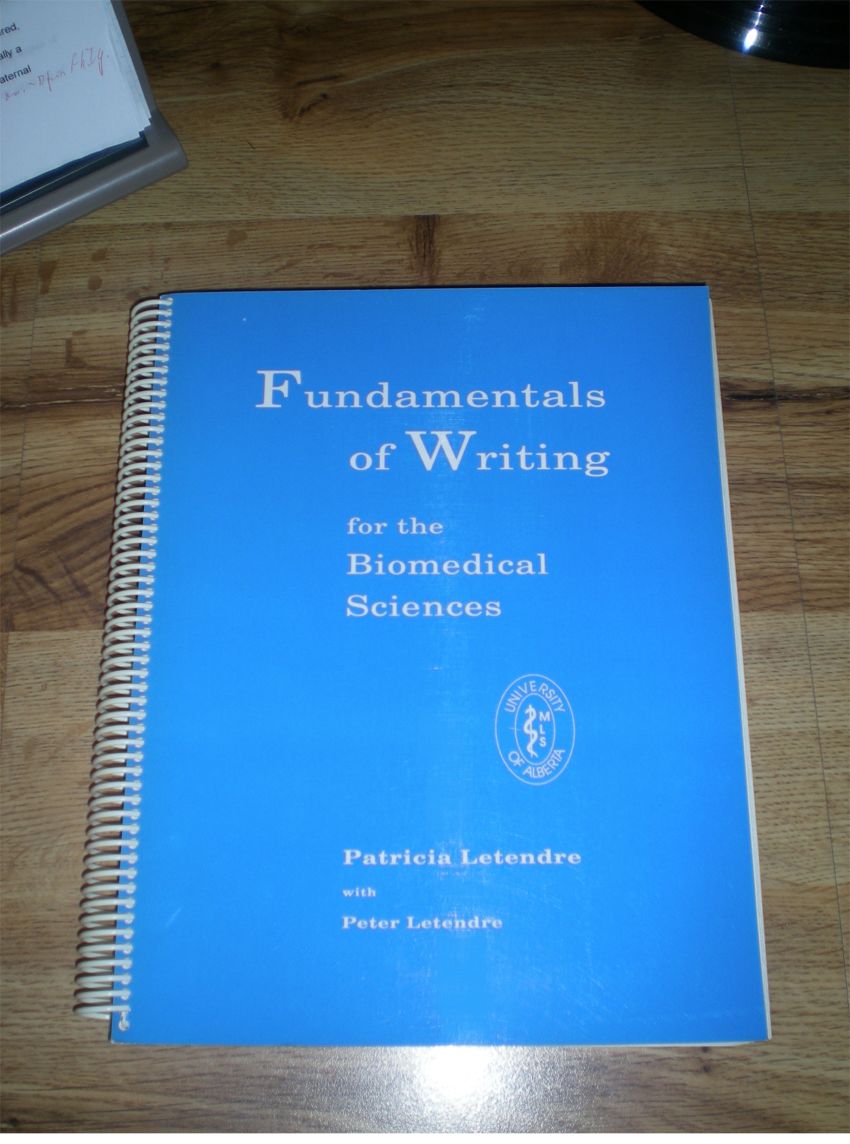
scientific writing. The CE course was based on a book written as a supplement to MLSCI 320, Fundamentals of Writing for the Biomedical
Sciences, later translated into Japanese, as Wakariyasui igakueigoronbun.
Of 100s of participants, Lisa achieved the highest grade. Since this was
pre-Internet, the course was an old-fashioned, paper-based correspondence
course.
Anyone who has
evaluated written papers, essays, and the like, knows that grading them is
sheer hell. Which is my way of saying that marking Lisa's assignments was pure
pleasure, forever endearing her to me.
What follows is Lisa's story from bench lab technologist to Learning Management System and Website
Content Specialist. Regardless of your current professional role, her
narrative has lessons for all.
`````````````````````````````````````
GUEST BLOG by Lisa
Denesiuk
How did I get
here?
It was a long and
winding road (Pat will insert appropriate musical link - see later), which is ironic (ditto on an old Alanis Morissette song) because one
of the reasons that I chose the medical laboratory profession was that I liked
the straight line from finish this
program to get this job.
Straight Path
Twists in the Road
My next job involved
moving off the bench and off shift work. I assisted rural transfusion services with maintaining competency and updating
procedures and implementing new processes (such as a redistribution program for
near-outdate group O RBC). I was a consultant but under the auspices of my
employer’s contracts rather than on my own.
Then the
off-the-bench road developed more switchbacks.
Another round of healthcare
restructuring meant that there was not enough transfusion medicine within
my employer’s portfolio to support a full time transfusion specialist.
I had to choose
between switching employers and switching career focus.
Fork in the Road
Choosing to stay
with my employer, I moved into departments and jobs with difficult to explain
titles like ‘Strategic Initiatives’ and ‘Business and Technology Analyst’.
The beauty and
the horror of the coordinator/ analyst/ specialist/ consultant jobs were that I
was never quite sure what I would be doing next. Obviously horrific for someone who likes straight
lines, but really beautiful for someone who likes to learn new things.
On a personal scale,
my career choices allowed me to develop some advanced software skills (I am
still one of the go-to people in my company for advice on making Excel® charts
with three axes, though I could never get the hang of pivot tables). I also
learned and re-learnt a lot about the non-transfusion laboratory disciplines.
And most
importantly, I had to maintain the knack for learning new things quickly
(assuming I wanted to stay employed, pay off my mortgage, and continue to
supply my cats with organic cat food, which of course is non-negotiable). Which
leads to my latest job...
And where is
‘here’?
My new job title
is Learning Management System and Website
Content Specialist. The font on both the paper and electronic business
cards keeps getting smaller and smaller.
The back story. .
.
- My
employer bought a learning management system (LMS-software to track learning)
and learning content software (LCMS- to build eLearning courses) about 2 years
ago.
- Originally,
consultants built our first few courses based on information provided by
supervisory and experienced staff members.
- It
took about 1 year to get everything ready for a launch to employees. Then. . .
- About
2 months before the date set for the launch, the employee in charge of the LMS
transferred to another department.
- At
that time, the organization decided to bring the course building in-house. So
the ‘team’ was reorganized into one ‘content specialist’ (i.e., laboratory
geek) and one ‘developer’ (i.e., IT geek). I’m the lab geek.
Needless to say with both of the team members having < 2 months to learn the LMS themselves before explaining it to 1100 employees (> 500 in one-on-one sessions), our first few months on the job were hectic!
Why was I the
‘chosen one’?
- Served
on the committee that investigated eLearning providers and suspect that the
questions asked during this process demonstrated an understanding of life-long
learning and a passion for the topic. (Likely the main reason the position was
offered.)
- Gained
much informal teaching experience in my laboratory career, but current boss was
probably unaware of most of it.
- Discovered
early that I loved to teach and succeeded at it. Almost from the moment my probationary
period ended, I was a preceptor while on the bench.
- While
a TM consultant, I often gave review sessions to staff in the rural hospitals
and presented at conferences.
- Participated in continued professional
development in various formats over the years, but again current boss probably
didn’t know about that.
A self-confessed CE junkie, I’ve added several letters
behind my e-signature:
SBB blended program (2 weeks
on-site within a full year course of distance education) from the University
of Texas Medical
Branch.
Took instructor-led courses, paper-based distance courses, electronically delivered courses, blended courses, courses for fun, courses for work, courses for professional development ... name a course type and I have probably taken at least one example.
Also volunteered
a lot for professional organizations, which is an amazing source of informal
education. Plus you get to know the most incredible fellow laboratorians.
Unexpected Opportunity Knocks
You
never know what unexpected opportunities will develop from something that seems
straight forward. I finished the UTMB course, passed the ASCP SBB exam and went back to my life.
Then
a couple years later I was asked to write the ABO chapter for a new transfusion textbook, because my SBB
instructor recommended me to the book authors. I wrote the chapter and then a
couple of years later was asked by the book authors if I would like to become
the fourth co-author on the textbook because they were stuck and needed some
change to kick start the project.
And several
years later we are on the final push to meet our deadline so the first edition
can hit the shelves in June 2013. And for the last few months I have been in
charge of developing the figures. All of a sudden I can do intricate stuff in
Visio® because years ago I took an SBB course, not an obvious outcome.
What does a
content specialist do?
My core function is as interpreter. . .
I’m the go-between for the subject matter experts (SMEs) and the developer. To
illustrate, my position includes:
- Listening
to what the SMEs want. Love this
acronym. Doesn’t it conjure a picture of a scholastic smurf-like creature? I
often have to hone their focus to something manageable.
- Investigating
the topic, then building a storyboard (think PowerPoint® with notes about
animations, pictures, pop up boxes, rollovers, etc.) and an exam question
bank.
- Facilitating
the review by SMEs and, after tweaking, handing the storyboard over to our
developer (IT geek) to build the eLearning course.
- Helping
if the developer doesn’t understand some laboratory-specific process or jargon
or what my storyboard notes mean.
- Coordinating
the course rollout to appropriate staff members.
Concrete
example:
- SME’s
manager: ‘We want to reduce our data entry errors.’
- Me to
the quality department: ‘What are the 3 most common data entry errors we see?’
- Me to
the SME: ‘Can I sit in on your 2-day in-person training session for newly hired
laboratory assistants?’
- Me to
the IT geek: ‘Here is the first of 3 storyboards about data entry - it is all
about entering patient demographics correctly.’
- IT
geek to me: ‘Do you really want to say Order a DPHON on this slide or is this
some bizarre typo?’....Reply: ‘Yes, that
is a comment that our laboratory information system recognizes and it
translates to …and the laboratory assistants will know what that sentence means.‘
- Me to
the LMS via writing an ongoing rule: ‘Enroll all laboratory assistant IIs who
work in patient care centres in the first data entry module.’
What do I love
about my job?
- Getting to teach again
- Opportunities that electronic learning presents
- Great potential to help our staff members, who are geographically scattered
- Learning or re-learning many different topics
- Working with new technology and coming up with creative solutions to obstacles
What I don’t
like about my job?
Unfortunately, I’m
- Sad when hearing that staff members see eLearning as an imposition rather than a benefit.
- Frustrated when the priorities we work on change after every meeting and consequently for months nothing ever seems to get to the finished product stage.
Most frustrations relate to being in the
midst of a cultural change.
Half the management and executive team seem to see eLearning as the magic pill
that will cure all ills and the other half are not convinced that time, energy
and money invested in the system will result in a good return on investment.
I’m sure the reality will fall somewhere in the middle, but in the meantime, we
are caught between widely divergent, and often unrealistic, expectations.
My own
learning journey
What if you
wanted to become a learning content specialist?
- Structured
programs about building eLearning (IT geek part) and about delivering adult
education (lab geek part) are expanding. Consider taking a few courses.
- A
content specialist requires strong communication skills as the
bedrock, and experience is the best top soil. (What I bring that the consultant
could not was credibility with the SMEs. Being able to talk the lab talk goes
a long way to smoothing over differences of opinion).
- The mulch in the metaphor
is being able to learn both lab topics and new software quickly.
- My
best advice is to be open to opportunities, which often cloak themselves as
‘more work projects.’
FOR FUN
As noted, the blog's title derives from these songs
Comments are most welcome BUT, due to excessive spam, please e-mail me personally or using the address in the newsletter notice. I’d
love to hear how you prepare to advance and expand horizons beyond
the typical career ladder.