Thursday, March 14, 2013

Stop children, what's that sound (Musings on commercialization of our blood supply)

Updated: 1 Nov. 2013 
Also see CSTM's reply to 'Stop children, what's that sound'

This month's blog has two sources:
  • Application by AABB (and others) to have whole blood (WB) and red blood cells (RBC) added to WHO's Essential Medicines List (EML)
  • Brouhaha in Canada over the possibility of for-profit blood donor plasma clinics opening
The blog's title derives from a 1966 Buffalo Springfield song written by Stephen Stills (later of Crosby, Stills, Nash & Young), 'For What it's Worth', better know by one of its lines:
  • 'Stop Children What's That Sound'
The blog's sources are related. With apologies to Bill Clinton's 1992 'war room' election slogan, "It's the commercialization, stupid."

Below are my musings on both sources. First I'll try to make sense of the complexities of the AABB move to make whole blood and plasma 'essential medicines' and then briefly relate personal experiences with being paid for my plasma.

AABB APPLICATION TO MAKE WB and RBC 'ESSENTIAL MEDICINES'

Where to begin? First, let me admit that this is a complex issue beyond my pay grade, as the saying goes. I'm discussing it because something seems wrong, does not compute.

Navigating all the complexities of AABB's application for WB and RBCs to be included on WHO's essential medicine list (EML) would make your eyes glaze over. Here's the key points as I see them.

For the 'full monty', read AABB's Dec. 2012 application

AABB claims that adding WB and RBCs to the WHO ESL would do many good things, e.g.,

  • Underscore government's responsibility to ensure financially sustainable funding and support for a safe and adequate supply of blood 
  • Emphasize the need to ensure that blood is cost-effective, affordable and available
  • Enable appropriate regulatory oversight of blood collection, processing, testing, storage and distribution to ensure the safety and quality of blood and the safety and efficacy of blood transfusion
On the surface, it seems like a no-brainer right? But perhaps all is not as it seems.

I call this the AABB application because it's on their letterhead. CBS seems not so much a co-sponsor as a co-opted, tag-along partner. Its CEO Graham Sher is AABB President-Elect.

And it turns out that the ISBT is not a co-sponsor. In a submission to WHO, ISBT notes that while the AABB application may have merit in principle (note reference to 'AABB application'), more time is needed to assess its full implications and ISBT never intended to be a co-sponsor in the first place.

Embarrassingly, on 8 Mar. 2013, the AABB CEO apologized that the application mistakenly included ISBT, a Yikes! if there ever was one.

Comments on the WHO website are informative. While there are many supporters, including CSTM,
it's interesting that many developing countries do NOT support the AABB application. 

Indeed, the European Blood Alliance, which includes the UK and other Euro nations, does NOT support the application. EBA believes that more time is needed to assess the implications and that proven strategies to improve safety and sustainability in developing countries should be tried first.

Makes me wonder on what evidence my own country's professional association (CSTM) sent a letter of support. Was it a case of busy professionals more or less rubber stamping an initiative of the 'big boys on the block' (AABB, CBS)? [See CSTM's reply.] The same goes for other supporting individuals and associations who qualify as 'kids on the block.'

For complete details of pros and cons, read the comments on the WHO website.

In brief, the concerns are that labelling whole blood and RBC as 'medicines/pharmaceuticals' could lead to 

  • Commodification (treating blood as a commodity to be bought and sold)
  • Commercialization
  • Decreased availability
Commercialization would threaten the volunteer, non-renumerated blood donor (VNRD) system. 

Dissenters from many countries point out that adding plasma derivatives such as immunoglobulin to the WHO EML has not brought about the 'goodies' that AABB claims in its application. For example, those advocating caution note that the commercial market for plasma products resulted in over-consumption in some countries and under-consumption in poorer ones.


The latest entry is from Harvey G. Klein of NIH. Dr. Klein is a past AABB president and strong proponent of the current initiative. 
In his rebuttal to Expert Review 2, Klein writes, 'There is no evidence whatsoever that adding blood to the EML will encourage commercialization.' Then why do so many other experts raise the issue? Are they all paranoid? Klein would have us believe so.

So why has AABB applied? Why now? And why do they and their surrogates seem in such a rush? What's really happening?

Times are tough in the transfusion world. Blood centers and transfusion services alike are in full amalgamation and partnership mode to try to survive. (Perhaps more on this in another blog.)

Added 1 Nov. 2013: April 2013, final amendments Oct. 2013: WHO's Model List of Essential Medicines was amended to include blood and blood products (see p. 20), as championed by AABB. 

FOR FUN: The ongoing debate on adding blood to the WHO EML reminds me of The Empire Strikes Back. I leave it to you  to create a cast of actors for these key roles:
  • Chewbacca
  • Darth Vader 
  • Han Solo
  • Luke Skywalker 
  • Obi-Wan Kenobi 
  • Princess Leia
  • Yoda
Perhaps I'll offer a prize for suggesting who best represents The Dark Side? (grin)

PAYING FOR PLASMA
This issue is relatively straightforward and I have personal experience with being a paid blood donor.

In the USA paying donors for whole blood donations stopped many years ago in the aftermath of the AIDS disaster in the USA and developed world. Canada's 'tainted blood' tragedy is well documented, but one occurred in every country.

In Canada paying for whole blood donations never existed. However, paying for plasma donations continued in USA until the present and first appeared in Canada in the 1960s.

Personal reflections on paid plasma donation in Canada

In Winnipeg at the Canadian  Red Cross Blood Transfusion Service (CRC BTS)  where I worked in ancient times, the so-called 'Rh ladies' with high titre anti-D (who had fetuses die from HDFN) got a small fee of the order of $15 per donation "for their time." Their plasma was processed into Rh immune globulin.

These women felt personally indebted to the Winnipeg Red Cross medical director, Dr. Jack Bowman, because most had infants saved by intrauterine transfusions performed by him.

Their anti-D was boosted and kept high by periodic injection of D+ rbc (cDe K-negative, to prevent stimulating anti-K and other Rh antibodies like anti-C or anti-E).

Today, Winnipeg-based Cangene pays plasma donors fees depending on how valuable their plasma is.

High titre anti-D donors are likely paid the most.

As a child prodigy medical technologist at CRC BTS in the mid-1960s, I earned $5 per donation for donating my group A plasma (containing anti-B) to prepare ABO typing sera. One of my  female group B co-workers similarly donated anti-A.

We were injected with group A and B substance to boost our titres. But staff plasma donations for ABO typing sera came to an abrupt halt when my pal delivered a newborn suffering from ABO hemolytic disease of the newborn.

My plasma donations were hardly big business. To my knowledge, the plasma was used to make in-house reagents for my employer, Canadian Red Cross BTS.

Now true for-profit plasma clinics are on the horizon in Canada, but not yet licensed by Health Canada.

Such commercial operations are common in the USA and elsewhere but do not exist in Canada. But Canada buys plasma products sourced from both volunteer Canadian donors and paid donors in other countries.


Paying for 'special' plasma with potent anti-D is one thing, especially if the fee is so low as to be paying an honorarium for a donor's time. 

Routinely paying every Tom, Dick, and Jane is another. It would undermine the volunteer donor sector. 

One leading light who strongly supports the need for paid plasma donors is CBS CEO Graham Sher (and AABB President Elect):
Dr. Sher points out that with modern screening and testing even products from paid donors are extraordinarily safe today. 
More Musings (16 March, 2013)

Interestingly, in March 2012 when CBS closed its plasma collection facility in Thunder Bay, Ontario they cited a decline in demand for plasma:

Over the past two years, new replacement products and a decline in hospital demand have led to a decrease in the need for plasma for transfusion. Based on current projections, Canadian Blood Services must plan for a reduction of approximately 10,000 units to our plasma collection program this year. 

Yet in its March 2011 Financial Report CBS noted:

In 2010/11 Canadian Blood Services started a pilot program to purchase surplus recovered plasma from the United States (collected by organizations with an FDA licence) which will continue in 2011/2012.

As I wrote in a blog at the time, While my guitar gently weeps (Musings on CBS's ongoing behavior):

So, what's the scoop? CBS needs less plasma OR CBS needs less Canadian plasma because operating a Canadian plasma centre is more expensive than buying surplus plasma from the USA? If true, why not just say so? 

....And what ever happened to Canadian plasma self-sufficiency? Has it been abandoned because it's too expensive?  

From the CBS Annual Report 2007-2008 (p.22): 

This year, we also re-introduced the collection of source plasma at our existing plasmapheresis sites across the country, laying the foundation for Canadian Blood Services to improve our plasma sufficiency - one of the basic principles of the blood supply as outlined in Justice Krever's report.

So.....CBS's stance on plasma collection has evolved, but not in a straight line. The official party line been all over the place: 

  • Plasma self sufficiency (~2007)
  • Buy surplus plasma from USA (~2010, ongoing)
  • Close Canada's plasma centre because of decreased demand (~2012)
  • Strongly support need for paid plasma donors (~2013)
Sadly, you need to take what our national blood supplier says with a huge grain of salt because they obfuscate what's really going on.

This news item from Indiana, USA is informative:
In contrast, Toronto's planned plasma centre is next door to a mission for the poor and homeless.  

Now the Canadian Hemophilia Society has entered the fray: 

The Society's draft position supports the opening of paid plasma clinics with these provisos | My comments:
  • Collection of plasma from paid donors must not affect the ability of CBS or Héma-Québec to collect fresh blood components | Something that remains to be seen
  • CBS and Hema-Quebec should increase the quantity of Canadian plasma for fractionation from non-paid donors | Héma-Québec, which plans to open a plasma centre in 2013, may increase the volume of Canadian plasma, but CBS closed its sole plasma centre in 2012 citing decreased demand (while at the same time buying surplus plasma from the USA to produce blood derivatives).
The CHS background Paper notes:
  • Not-for-profit blood establishments do not consider it economical to recruit non-paid donors for a self-sufficient supply of plasma for plasma-derived products; 
  • they choose to rely on the highly efficient for-profit global plasma collection and fractionation industries. 
  • Therefore the reliance on source plasma from paid donors will only increase.
  • If Ig receives an indication for Alzheimer's disease (it is currently in Phase III clinical trials), the demand for Ig (and plasma) will skyrocket.
In other words, time for Canada to get on the bandwagon, go with the flow? The flow of cash? A giant sucking sound of tax-payer money going to plasma centres and associated pharmaceutical companies who then fund research to create more demand for IVIG, et al? 

Hmmmm...sounds like a plan.


Philosophical issues


Margaret Sumerville, Director of the McGill Centre for Medicine, Ethics and Law, examines philosophical arguments related to commercializing the human body and the 'disturbing image of middle men making large profits out of one person's poverty and another's dire medical need.'


LEARNING POINTS

To me, all is not as it seems with AABB's application to WHO. CBS as a co-sponsor seems a joke. Not Britain or Australia or New Zealand....Not any of the countries represented by the European Blood Alliance.

Why Canada? Because Graham Sher is AABB President-Elect? Because Canada is so much wiser then Germany, UK, etc?

More importantly, the nations supposedly most to benefit are skeptical or outright oppose it.

What's wrong with this picture?

As noted in past blogs, AABB as an organization is cozy with industry, indeed depends on it heavily for funds via advertising and exhibiting services and products at annual conventions. AABB Consulting is another business line and money earner.

Is AABB's application to add WB and RBC to the WHO ESL merely an altruistic desire to improve blood safety, accessibility, and sustainability for developing nations?

I'm a cynic. As George Carlin said, 'Scratch any cynic and you will find a disappointed idealist.' But cynic or lapsed idealist, the AABB move doesn't seem right. What's going down?

FOR FUN
The song that fits this blog is

I think it's time we stop, children, what's that sound Everybody look what's going down
Comments are most welcome.

Tuesday, February 12, 2013

Don't worry, be happy (Musings on the loves & hates of a lifetime in transfusion medicine)

In honour of Valentine's Day, February's blog is about some of the things I've loved about transfusion medicine over the years. See how many jive with yours. And don't worry, the blog won't be too sickeningly sweet. That's not me.

The blog's title comes from a 1988 ditty by Bobby McFerrin. 

LOVES

1. Organized chaos in the transfusion service laboratory

Phones ring - timers go off - specimens and requisitions arrive - perform historical checks in computer - RBC needed STAT for gunshot wound - aortic aneurysm has blown - start massive transfusion protocol - thaw frozen plasma - night tech calls in sick - patient has positive antibody screen - identify red cell antibody - exclude possible antibodies - open donor segments to antigen type - pos control doesn't work - repeat the test - short of O Rh neg RBC - call blood supplier for more - patient specimen arrives whose ID doesn't check with what's on requisition - call nurse on ward, take flak, stay calm and explain - etc. 

Whew! Time to leave already? How time flies when you're having fun.  Brief next shift and go home feeling satisfied and proud of what you do.

2. Managers who...
  • Don't play favorites and develop transparent processes for how perks, if any, are allotted
  • Regularly thank staff for a job well done
  • Tell you when you screw up (in private) and suggest how to improve, so that you can
  • Don't stay cocooned in their office but instead walk around, observe, and talk to all staff 
  • Go to bat for staff with higher ups and other departments and never, ever diss staff in front of others
  • Encourage staff to learn and, whenever possible, offer accessible, inexpensive opportunities for continuing education and professional development
  • And especially practice Steven Covey's advice for building trust by being true to those who are absent.
Being true to those who are absent means never discussing one staff member in a disrespectful vein with another, i.e., not gossiping and backbiting others. 
A manager with a track record of talking about others behind their backs quickly loses trust.
3. Colleagues who...
  • Keep positive inside and outside the lab, as opposed to holding bitch sessions at coffee about the latest 'rotten' thing that management or 'the system' did
  • Put in close to 100% effort or more, most of the time, realizing that we all have bad days
  • Share knowledge and experience generously as mentors and consciously model how experts think about problems
  • Practice reflective thinking about work-related issues (technical, clinical, educational, etc.) and their own lifelong journey to develop expertise
  • Have empathy for new staff and students, realizing that if one person is elevated, we all are. 
  • Motivate colleagues by holding up a mirror and showing them a positive image. 
As George Bernard Shaw said of friends, 'The only service a friend can really render is to keep up your courage by holding up to you a mirror in which you can see a noble image of yourself. '
4. Health professionals (physicians, nurses, technologists, pharmacists, etc.) who...
  • Respect laboratory and all health professionals for their unique skills and expertise
  • Treat colleagues in different health disciplines as equals, regardless of relative status in the health care pecking order
  • Show respect and kindness to all staff, especially non-health professionals who do the scut work in hospitals and blood centres with little pay and status
5. Students and trainees who...
  • Accept constructive criticism, even when it hurts, realizing it's the only way to improve
  • Recognize that educators and trainers are people too and cut them slack from time to time
  • Ask questions and challenge the status quo 
  • Listen carefully
HATES
Obviously, the opposite of the qualities above but also
  • Manufacturers and suppliers who distort truth about their products and services, even a little, in order to gain sales and maximize profits
  • Health professionals in senior positions who become cozy with industry and end up becoming their de facto poodles
FOR FUN
For all colleagues who practice my 'loves':
And for Valentine's Day, many songs fit but I favour this one by Canada's Celine Dion
As for 'hates', I try to practice the advice in Bobby McFerrin's song
In every life we have some trouble - When you worry you make it double - Don't worry, be happy...... 
I'm sure I'll add to the list in the following days. If you have any loves or hates to suggest or argue with, please comment below. 

Saturday, January 12, 2013

Do you believe in Omics? (Musings on genomics as the savior of pathology)

Updated 16 Jan. 2013

This blog was stimulated by this article in The Scientist:
In it the authors jump on the OMICS bandwagon, specifically genomics and urge pathologists to seize the day to establish the future of pathology in personalized medicine, a field that emerges from applying genomics to clinical decisions.
They* write that pathology is the backbone of modern medicine and its impact has relied on technological advances, e,g, light and electron microscope, digital imaging, polymerized chain reaction, and now genomic sequencing. 
*Authors are from Harvard Medical School. Dennis Wall is Director of Computational Biology. Peter Tonellato is Director of the Laboratory for Personalized Medicine and heavily involved with promoting pathology in personalized medicine. 
Not sure that pathologists feel the love supporting the 'backbone of modern medicine'. Girdles were never very sexy. Several have told me that they occasionally feel they are at the bottom of the physician totem pole, more like a jockstrap. 

It's analogous to how medical laboratory technologists / scientists (lab boy, lab girl in the recent past) feel compared to higher salaried and more respected docs and nurses. 

Before musing about transforming pathology education, let's briefly review OMICS, a term with many types and a plethora of definitions. I like this site as it's not replete with bafflegab:
MUSINGS
Back to revolutionizing pathology education. The bit in the article that most got me was the need for core competencies in genomics and personalized medicine, and it is likely that "within 2 years it will be required that all residents in pathology demonstrate proficiency in these areas." 

Wow! Competencies and proficiency impose heavy duty training needs. Quite different from the meaningless learning objectives (educators, bear with me) that too often accompany physician presentations:
  • Become familiar with the complications of blood transfusions
  • Learn about blood components and products
  • Understand how to select the best blood product
Describing the characteristics of good learning objectives, the kind needed to measure competency and proficiency, is not my goal. Mentioning them is just to emphasize that educating and training to achieve competency and proficiency are rigorous.

I'd prefer that educational institutions first focus on giving all medical and nursing students, and practitioners whose initial education training was lacking, a few key competencies in transfusion medicine. 
Fact is that undergraduate medical education everywhere devotes little time to transfusion medicine. Several reasons, but they include lack of time in an already jam-packed curriculum and perceived low priority compared to other education needs. Nursing education is similar.

The result is that errors in prescribing and administering transfusions occur all too frequently. 

Soooo... Before revolutionizing medical education by training pathologists to be proficient in genomics and personalized medicine, perhaps medical and nursing education should deal with existing deficiencies as documented in 
Sure, let all pathologists, indeed all health professionals, know about, be aware of and understand genomics and its relevance. Perhaps even develop specialty training.

It's not like pathologist education isn't rigorous enough already. For example, residency programs in :
Spending scarce educational resources transforming pathologist education to make genomics a priority seems ridiculous. Those who advocate it have personal agendas to promote their specialty. They are true believers, as it were. No doubt OMICs will evolve and become increasingly important. Exactly how is impossible to predict. 

Will genomics and personalized medicine be ~ blood substitutes (aka hemoglobin-based oxygen carriers and similar), over-hyped and a long time coming? My guess is yes, mainly because disease is complex and determined by genes, environment, lifestyle, and more. As well, there are many other competing medical advances and health initiatives that can improve health more effectively, better diet and more exercise, to name but two.

As hematopathologists, transfusion nurses, and medical laboratory technologists and scientists who work as specialists in transfusion services are well aware, the competency of many, perhaps most, physicians who order blood, and nurses who administer it, ranges from dismal to needs improvement. 

And since blood transfusion is common, you'd think being competent would be basic to all docs and nurses who prescribe and administer transfusions, an educational PRIORITY. 

Apparently not. More hip to promote genomics and be seen as visionaries. 

Oh, did I mention that industry is very keen on genomics and personalized medicine? See 2010 blog:
FOR FUN
Seems that OMICS is the new religion with many true believers, which reminds me of another true believer, Kathy Bates in Primary Colors, one of the best political films ever. 

The music below was selected to contrast techie innovation with an instrument that has been around for hundreds of years. 

First, this 1998 'techno' song by Cher, one of the best selling singles of all time. If you dislike this music, you may sympathize with those pathologists who hate techie innovations, because it threatens their comfortable ways.
But if you love pure simplicity, nothing beats the Spanish guitar played by the most complex of tools, evolved over 200,000+ years. (grin)
FURTHER READING

OMICS in personalized medicine (2010 European Commission workshop)

Personalized medicine: caught between hope, hype and the real world. Clinics (Sao Paulo). 2012;67 Suppl 1:91-7.

Platelet proteomics in transfusion medicine: a reality with a challenging but promising future. Blood Transfus. 2012 May;10 Suppl 2:s113-4. 

Shaking hands with the future through omics application in transfusion medicine and clinical biochemistry. Blood Transfus. 2012 May; 10(Suppl 2): s1-s3.


Tuesday, December 11, 2012

Here Comes the Sun (Musings on putting fun back into transfusion medicine)

Updated: 28 Mar. 2021 (Fixed links)
This month, some light fair for December, Here Comes the Sun (Musings on putting fun back into transfusion medicine). The title comes from one of my favorite George Harrison songs.

The blog was stimulated by the Royal College of Pathologists of Australasia social media campaign to encourage viewers to imagine a "World Without Pathologists." Gee, I often dreamed of that when working in the transfusion service lab and later, when teaching. Just kidding, sort of.

THE FUN STUFF 
 Some videos that I hope will tickle your funny bone. 
First, take-offs on 'Call Me Maybe' by Canadian Carly Rae Jepsen, which is up for a 2013 Grammy as Song of the Year.
Non-health versions:  Many health professionals use XtraNormal to produce fun videos that highlight the in-jokes of inter-professional relationships. Examples:
Medical schools have a tradition of producing humorous videos. One that I particularly enjoy is by University of Alberta med students:
Very funny, give it a chance. Part 2 has its moments too.

Hope you get a few chuckles from these inside jokes. If you know of similar videos, please let me know. 

FOR FUN
The blog's title comes from one of my favorite Beatle ditties. I live in Edmonton, the northernmost city in North America but we are one of Canada's sunniest cities, getting more than 17 hrs. of sun per day at summer solstice. 
And just because this clever remix with Rita Hayworth dancing in 10 of her movies is fabulous:
If this doesn't make you feel good, you're not alive. Also enjoy original with John Travolta strutting his stuff:
Comments are most welcome and can be anonymous or under your name.

Merry Christmas, Happy Chanukkah, Happy Holidays to all.

Wednesday, October 31, 2012

You don't own me (Musings on TM professionals as industry's poodles)

Updated 1 Nov. 2012

This month's blog is about how much of the TM information we consume is meant to inform, how much is crafted to persuade, and how much info purveyors assume we’re owned by them, i.e., their poodles. The title is from a 1964 Lesley Gore song. 

The blog was stimulated by 3 items:
1. Supposed news from new-medical.net in its 'Insights from industry' section:
2. The article motivated me to visit OCD's 'On Demand' website and register to see its offerings. 

3. Then I was reminded of a recent research paper by OCD staff published in AABB's Transfusion:
BACKGROUND
Increasingly, I suspect that industry owns the transfusion medicine community. In a way, it's natural given that TM was healthcare but now is business and has been for awhile. Businesses depend on each other to survive. You scratch my back and I’ll scratch yours.

Today's AABB is more and more cosy with commercial interests, which is also natural given the reliance of the former on the latter for advertising revenues and conference support. Plus, as noted in earlier blogs, some AABB luminaries have close ties with industry. It's one big happy family.

The blog’s components  - industry promoting automation via 3 mechanisms - are akin to a full court press in basketball in which industry pressures TM staff from every angle to buy into their false assertions about automation.

The blog's theme is how much industry thinks it owns us and attempts to baffle our brains with BS. 

A common thread in industry’s automation initiative is to create false arguments. For example, manual methods have more processes than automation (true), therefore automated instruments have fewer chances for human errors to occur (true). 

BUT… here’s the logical fallacy (the BS, if you will): Where do most serious TM errors occur? Are they related to manual testing? 

Read and assess for yourself.

1. INTERVIEW
First note where this interview was published: news-medical.net

As with many so-called health sites, news-medical's business model is not immediately apparent without reading the fine print. And let's face it, that's the first thing we do when visiting a website, right?

Part of the 3239 word, 27 point,Terms and Conditions:
News-Medical hereby discloses that a commission or listing fee may be payable by Experts to News-Medical for any fees received by them as a result of an introduction of a client through the Website.  
Unsurprisingly, the site's underlying purpose is to sell stuff.

Besides industry news, news-medical, based in Australia, cheaply repackages health information from several sources, including a heavy reliance on Wikipedia under the Creative Commons Attribution-ShareAlike License.

Below is my summary of a few highlights of OCD’s Celia Tombalakian's interview with news-medical.net in question and answer format, with my comments, aka musings, in italics. Readers are directed to the full interview for exactly what she said. 

The report is selective and my approach is facetious in places. But is it off the mark? You be the judge.

QUESTION: How is the blood banking industry currently being transformed?

CT's ANSWER
CT: Current focus is to improve transfusion safety and efficiency through technology solutions.  
Ah, safety and efficiency, with safety mentioned first. Who can argue?
CT: Over past 20 yrs, the number of highly skilled technologists and scientists entering the global TM workforce has shrunk. 
CT: Therefore, automation is becoming a standard part of blood bank laboratories because it eliminates many of the labor-intensive, time-consuming manual testing that requires specialized skills and significant experience to master.  
Really? Her response implies that automation arose because of staff shortages, which misleads in a chicken and egg sort of way.  
Why has the highly skilled technical and scientific TM workforce shrunk? Many reasons around the globe, inc. poor compensation for education involved (mainly USA), decreased health care funding, leading to regionalization and centralized testing, all facilitated by automation.  Automated instruments continue to be marketed on their ability to decrease absolute numbers of highly skilled staff.
CT: Ultimately, automation can increase a lab’s capacity and help it operate more efficiently, even with a smaller staff. 
A case can be made for how instruments are more reliable than humans, at least for some things. But notice there's no more mention of safety, only efficiency.
QUESTION. Tell us about the new Bloodbanker App and its benefits over traditional blood banking tools.

CT's ANSWER
CT: ORTHO's Pocket Blood Banker app is an educational reference tool that combines genotyping and antibody indexing. Users can quickly determine genotypes based on results with Rh antisera via the Genotype Calculator and learn more about antibodies with the Antibody Index.
CT: Prior to the app, blood bankers used reference tools such as cardboard slide rules. 
You gotta be kidding. Cardboard slide rules? Maybe that's what Ortho supplied customers back in the Jurassic age, but for decades I and many others taught MLS students how to determine Rh genotypes using their ... wait for it ... inbuilt computers, aka brains.

Reminds me of this exquisite Danish humour on computers: Medieval helpdesk
CT: Drawing from a deep understanding of the importance of and need for innovation in blood banking, OCD identified the need for more advanced tools and developed this new technology. The app reinforces our commitment to providing innovative solutions to our customers. 
OMG, classic marketing and branding. We're wise, we're innovative, we're dedicated to helping clients. Please bring us cute babies to kiss. 
QUESTION: Could you introduce Ortho ON DEMAND and how it fits with OCDs overall focus?

CT's ANSWER
CT: ON DEMAND is an innovative virtual engagement platform that enables blood bankers to learn from and connect with experts on topics central to achieving science-driven safety and efficiency in the blood bank. 
Attempt to reinforce Ortho's brand as innovative, Also love 'virtual engagement platform' and 'science driven.' Buzzwords convey modernity and objectivity, respectively. And note re-introduction of the safety and efficiency double whammy.
CT: With OCD’s strong TM history, we understand the importance of supporting industry through education and awareness. 
We're the pros, we understand. Trust us.
CT: Because many of today’s blood bankers work longer hours with fewer financial resources, many laboratories have had to cut costs that previously supported career growth opportunities. Through our new platforms, we hope to help prepare blood bankers to address growing demands for TM expertise. 
Excuse me? Labs have had to cut CE and CPD funding because staff work longer hours with less money? Does not compute. Pure bafflegab.
As for helping a growing demand for expertise, is there a growing demand for expertise? If so, it's to address what automation created in the first place, namely a diminished demand for technical and scientific expertise with fewer positions for TM specialists.
Frankly, automation and apps both contribute to and help alleviate a 'dumbing down' of the profession. I acknowledge that 'dumbing down' is a harsh catch phrase for staffing with less qualified personnel, not that such staff are dumb. I use the term to emphasize that apps do not contribute to developing expertise, but rather exist to alleviate lack of it.
QUESTION. What impact do you think these initiatives will have on blood bankers?

CT's ANSWER
CT: Many of today’s blood bankers struggle to do more with less, working longer hours with fewer financial resources. Concurrently, instrumentation is more complex and the number of transfusions is increasing globally. 
Meaningless bafflegab. Yes, cost constraints force blood bankers to do more with less.  
But instrumentation is more complex? More complex than what? Earlier instruments? Manual testing? Do sales reps' spiels include these words?  "Hey, our instrumentation is more complex. You need better trained dudes to operate it."   
Also, in an age of blood conservation and a kazillion studies on real and unproven potential transfusion dangers, what evidence exists that transfusion numbers have increased? Does not compute.
CT: With reduced resources, many labs cut travel costs to learning events that could better prepare staff to address growing demands for TM expertise. Ortho ON DEMAND addresses this challenge by offering TM professionals free access to education according to their own schedules.
Offering free online education has merit. But it's not exactly true that today's over-worked TM professionals are clamouring to access education on their own schedules. Employers allot no time during work hours. Staff who are under-paid and feel under-appreciated are increasingly less motivated to take time away from families to further their careers.
QUESTION: How do you think the future of blood banks will develop?

CT's ANSWER
CT: While technology has made many routine BB tasks faster and easier, the demand for blood continues to rise and the pace of processing blood continues to accelerate.  
Demand for RBC transfusions (type that automated instruments process in transfusion service labs) is increasing? Where's the evidence? Surely all the efforts on blood management, blood conservation, and improved utilization are having an impact on RBC usage.
Pace of processing blood continues to accelerate? What does this mean? I could speculate but she doesn't explain.  
CT: Hemovigilance and ensuring efficiency is of utmost importance to blood banks in maintaining a safe and accessible blood supply while keeping pace with accelerating demand for blood processing. 
Sounds good but what has hemovigilance to do with OCD's automation and apps? And again the unexplained 'accelerated demand for blood processing.'
CT: The future of blood banks lies in technological solutions that will allow blood bankers to increase safety and efficiency in order to provide the best possible outcomes for patients. 
Motherhood statement. But where is the evidence that automated ABO and Rh group testing and automated antibody screening have improved outcomes for transfused patients? Or that apps that generate Rh genotypes and describe antibodies have made a difference? 
Surely, getting patient identification correct when drawing blood samples and correlating patient identity to crossmatched donor blood when administering blood remain THE hallmarks of safe transfusion practice, the 'right patient, right blood product, at right time' mantra. 
QUESTION: What are OCDs plans for the future? Would you like to comment further?

CT's ANSWER
OCD is the global leader in Transfusion Medicine, stemming from a 70-year history of protecting the safety of the worlds blood supply. We intend to continue our leadership of the market into the future, both with our products and through our service and support of the blood banking community. 
Forgive me, but I'm jaundiced. Although I've known, liked, and respected many Ortho reps, having just read Blood Medicine (aka Blood Feud) about Ortho Biotech and Amgen's marketing of EPO products, protecting patient safety as applied to J & J or any Big Pharma company rings hollow.
Author Q & A
2. WEBSITE

Simply put, Ortho ON DEMAND offers varied worthwhile educational talks by respected TM professionals, but promotes automation. To illustrate, the first 4 talks in its Presentation section are about automation. 

I'm reminded that Ortho and its competitors such as Immucor operate on a razor-blade business model: cheap razors (instruments), with the real money made on expensive blades (reagents).

3. RESEARCH PAPER
This paper by OCD employees further shows how industry treats TM professionals like poodles, hoping to baffle brains with BS. 
Interestingly, one of the authors, TS Casina, an OCD marketing manager, also penned these 3 articles:

Casina TS. Technologies to improve the future of blood banking. Med Lab Obs 2011 Oct;43(10):32. Excerpt:
  • 'As the labor force shrinks, the rapidly evolving field of laboratory medicine is struggling to keep pace with the growing demand for blood and its components. Automation is becoming a standard part of blood bank laboratories because it can help eliminate the labor-intensive, time-consuming manual testing processes that require specialized skills and significant experience to master.'
Casina TS. What's new in transfusion services. Advance for Med Lab Professionals. Posted online 19 Sept. 2012. Excerpt:
  • Transfusion of incompatible blood has the greatest potential for severe adverse events and health complications, including death. Fortunately, due to advances in transfusion medicine (TM) practices -improved blood testing, donor screening and the advent of automated systems - the blood transfused to patients is safer today than it's ever been.
Casina TS. References for "transfusion medicine reactions. Advance for Administrators of the Laboratory 2012 Oct;21(10):20. This paper is a reworked version of the one above. Excerpt: 
  • A study conducted by Ortho Clinical Diagnostics provides quantitative evidence of how automation could transform pretransfusion testing processes by dramatically reducing error potentials and thereby improve the safety of blood transfusion.  Evaluating the common testing methods above and leveraging failure modes and effects analysis (FMEA) to compare error potentials, the group concluded that automation significantly reduces defect opportunities in pretransfusion testing and could dramatically improve blood transfusion safety.
Can you see how marketing managers use a full court press and recycled material (with the help of willing publishers desperate for articles) to get their message out to industry's poodles, namely us?
Abstract Highlights (Transfusion paper)
BACKGROUND: Human error associated with manual pretransfusion testing is a cause of transfusion-related mortality and morbidity and most human errors can be eliminated by automated systems. 
STUDY DESIGN AND METHODS: Study’s goal was to compare error potentials of commonly used manual (e.g., tiles and tubes) vs automated (e.g., ID-GelStation and AutoVue Innova) group and screen (G and S) methods. G and S processes in 7 TS labs (4 with manual and 3 with automated methods) were analyzed to evaluate error potentials of each method.
Tiles?  Really? Well, they could be large welled plates. But who uses these in routine manual pretransfusion testing?  
RESULTS: Manual methods contained more process steps ranging from 22 to 39; automated methods contained 6 to 8 steps.  
Roughly 4-5 times more steps for manual methods. Authors then use ‘risk priority numbers’ (RPN)  - trust me, you don’t want to go there -  to show manual method RPNs ranged from 5304 to 10,976 vs 129 and 436 for automated methods, conveniently making manual tests away more than 4-5 times as risky as automation.
What the hey! Let's go there. A team (needed to reduce subjectivity) of OCD researchers and staff at 7 TS labs determined how many defects were likely at each process step (defect opportunities) and decided where failures could occur, the likelihood that the failure would be identified, how frequently the failures might occur, and what the effects of those failures (severity) were. The result was a 10 point scale. An example: 
Process Step 16 (tile or plate required tapping and rocking before reading reactions) had 18 defect opportunities. 18 represents 6 wells in the tile or plate in which it was possible to undertap reactants (6 defect opps), forget to tap the plate (6 defect opps), or overtap and splash reactants among wells (6 defect opps) for a total defect opportunity of 18 at that step (6 + 6 + 6 + = 18). The severity was rated 7 out of 10.
Wow! Talk about creative number crunching to get the results you want. The mind boggles....
CONCLUSION: This study provided quantitative evidence on how automation could transform pretransfusion testing processes by dramatically reducing error potentials and thus would improve the safety of blood transfusion.
Oh sure. Is I or is I not your poodle?
MORE MUSINGS
This study’s logical fallacy posits (love that word!) that most, or even many, serious transfusion errors result from manual testing of ABO and Rh groups and manual antibody screening. It's true that manual testing has potential to create more errors than automated testing.

The best evidence of where TM errors occur comes from the UK’s annual SHOT Reports. For example, consider 
I’ll not bore you with too many specifics  - you can read for yourself - but believe me, it’s NOT all about lab staff making technical errors when manually testing. 

'Adverse reactions caused by errors' lists these causes of cumulative cases reviewed 1996-2011 (n=9925):
  • Anti-D errors 
  • Inappropriate & unnecessary
  • Handling & storage errors
  • Incorrect blood component transfused (n>3000)
To quote SHOT: Key lesson from 2011 is an emphasis again on the importance of the essential steps of the transfusion process:
  • Taking the blood sample from the correct patient 
  • Correct laboratory procedures
  • Issuing of the correct component
  • Identification of the right patient at the bedside at the time of transfusion
  • It is clear from the SHOT 2011 data that identification of the correct patient remains a key issue and that this must become a core clinical skill.
BOTTOM LINE
So, what's it all about? Yes, automation can increase efficiency and increase safety by reducing human error. But is automation the TM saviour that industry reps and some TM professionals make it out to be? 

When you examine the arguments of proponents, such as OCD's Celia Tombalakian or the research of OCD employees, their arguments do not stand up to scrutiny. They continually overstate how automated testing can improve safety and propose it as magic it is not. 

Companies have a vested interest in promoting automated testing since the business model of cheap razor (instrument) and expensive blades (reagents) is what makes their industry viable. 

Their multi-media advertisements are relentlessly promoted to TM professionals using flawed arguments that show they think they own us and we are their poodles. 

FOR FUN

Industry's seeming hold on so many TM professionals brings to mind:
  • You Don't Own Me (Same song re-worked for 2012 USA election - thoroughly partisan. ALERT: Depending on your politics, you may be offended.)
  • You Don't Own Me (Diane Keaton, Bette Midler, Goldie Hawn in 1996 movie The First Wives Club)
Comments are welcome but due to excess spam this section is removed. Please send comments to me personally.


Tuesday, October 09, 2012

The long and winding road - good vibrations (Musings on preparing for career advancement)

This month, I'm pleased to have a guest blogger, one of my 'kids' (former students, MLS grads, all of whom I'm extremely proud of):
  • Lisa Denesiuk, MLT, ART (CSMLS), MLS (ASCP), SBB (ASCP), BSc (MLS)
Earlier this year Lisa moved to a new position with Dynalife Dx and became a Learning Management System and Website Content Specialist. 

Intrigued by her job title, I asked Lisa to write a guest blog on how that came about and what was involved. Despite being a busy health professional, she graciously agreed.

The blog's title comes from an old Beatles song (naturally) and a classic by the Beach Boys. 

Why should you read this blog?
To me, Lisa's career path epitomizes a Louis Pasteur quotation:

  • Chance favors the prepared mind.
  • If you retain nothing more from this blog, remember this.
Educators like to tell students that their undergraduate degrees can take them in many directions. To me, careers beyond the routine are possible only if graduates actively continue to learn both formally and informally, and that takes much effort. 

Continuing education (CE) and continuing professional development (CPD) require commitment to learn outside of work hours, invariably sacrificing time with family and friends or relaxation time. Often it also involves spending one's own money, since today's employers seldom offer financial support to take courses or attend conferences, even if staff present at them.

Going to work each day and giving 100% is not enough. To prepare for future job opportunities, health professionals need to give blood, sweat and tears after hours.

For those of you who want to advance, who want to do something different, yet still use your basic health profession education and training, below is one person's path to an interesting career.

Advice from me to you: Instead of reading the way that busy health professionals usually do (i.e., rapidly scanning and racing through e-mails and websites without content registering in your mind), I suggest you sit back, take a few deep breaths, and focus on slow reading. If you don’t have the time right now, return to the blog when you do.

Slow reading is analogous to slow cooking, an alternative to fast food and something I now practice daily. Reading much transfusion-related news to decide if it’s worth reporting, I’ve had to institute the practice of slow reading. Try it, you’ll like it!

BACKGROUND
As background, Lisa is one of two former students who were awarded the ACMLT Award of Distinction.

Because she began work in a transfusion service, I followed Lisa's career with interest, as I do all MLS grads, especially those who are employed in transfusion laboratories or blood centres.

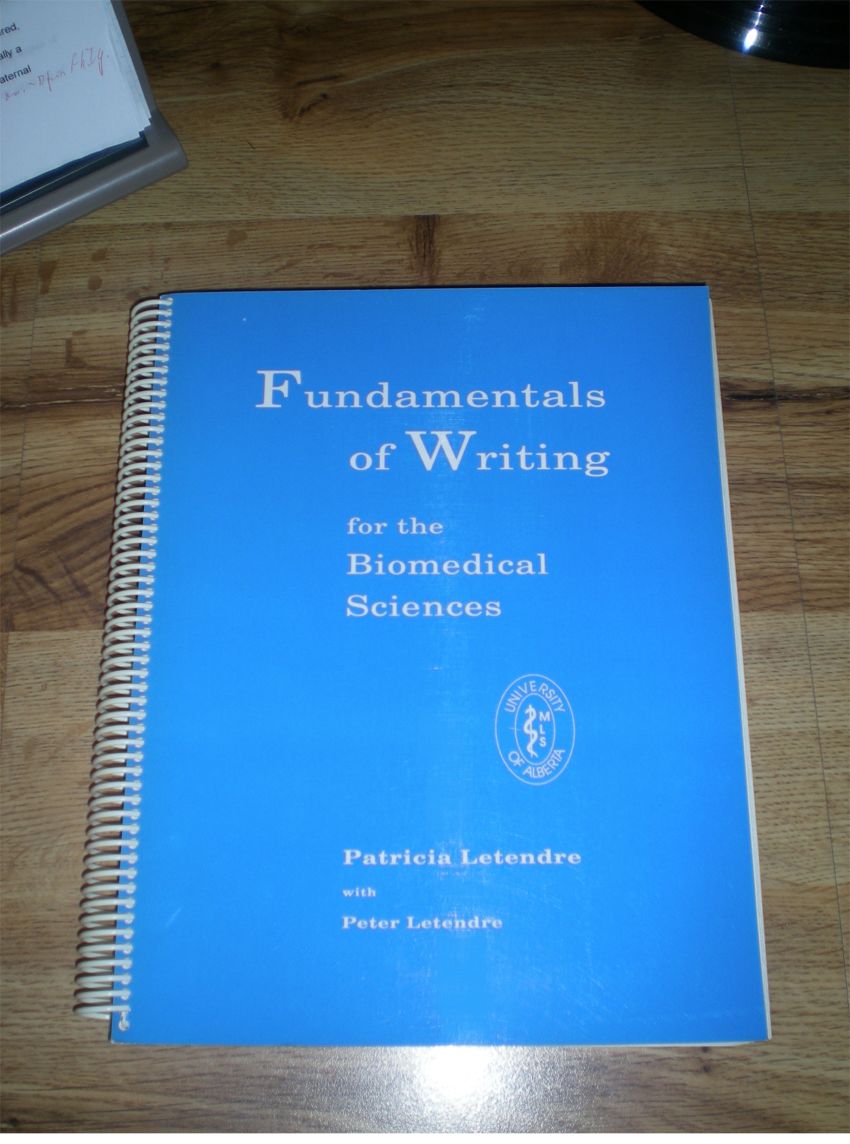
As well, Lisa took a CE course I offered by distance education on scientific writing. The CE course was based on a book written as a supplement to MLSCI 320, Fundamentals of Writing for the Biomedical Sciences, later translated into Japanese, as Wakariyasui igakueigoronbun.

Of 100s of participants, Lisa achieved the highest grade. Since this was pre-Internet, the course was an old-fashioned, paper-based correspondence course.

Anyone who has evaluated written papers, essays, and the like, knows that grading them is sheer hell. Which is my way of saying that marking Lisa's assignments was pure pleasure, forever endearing her to me. 

What follows is Lisa's story from bench lab technologist to Learning Management System and Website Content Specialist. Regardless of your current professional role, her narrative has lessons for all.
`````````````````````````````````````
GUEST BLOG  by Lisa Denesiuk

How did I get here?
It was a long and winding road (Pat will insert appropriate musical link - see later), which is ironic (ditto on an old Alanis Morissette song) because one of the reasons that I chose the medical laboratory profession was that I liked the straight line from finish this program to get this job.

Straight Path
I started out on that straight path, graduating from the University of Alberta Medical Laboratory Science program in 1987 and working (with a few minor detours) for 13 years on the bench in the transfusion service of a busy, inner city hospital.

Twists in the Road
My next job involved moving off the bench and off shift work. I assisted rural transfusion services with maintaining competency and updating procedures and implementing new processes (such as a redistribution program for near-outdate group O RBC). I was a consultant but under the auspices of my employer’s contracts rather than on my own.

Then the off-the-bench road developed more switchbacks.  Another round of healthcare restructuring meant that there was not enough transfusion medicine within my employer’s portfolio to support a full time transfusion specialist.

I had to choose between switching employers and switching career focus.

Fork in the Road
Choosing to stay with my employer, I moved into departments and jobs with difficult to explain titles like ‘Strategic Initiatives’ and ‘Business and Technology Analyst’. 

The beauty and the horror of the coordinator/ analyst/ specialist/ consultant jobs were that I was never quite sure what I would be doing next.  Obviously horrific for someone who likes straight lines, but really beautiful for someone who likes to learn new things.

On a personal scale, my career choices allowed me to develop some advanced software skills (I am still one of the go-to people in my company for advice on making Excel® charts with three axes, though I could never get the hang of pivot tables). I also learned and re-learnt a lot about the non-transfusion laboratory disciplines.

And most importantly, I had to maintain the knack for learning new things quickly (assuming I wanted to stay employed, pay off my mortgage, and continue to supply my cats with organic cat food, which of course is non-negotiable). Which leads to my latest job...

And where is ‘here’?
My new job title is Learning Management System and Website Content Specialist. The font on both the paper and electronic business cards keeps getting smaller and smaller.
The back story. . .
  • My employer bought a learning management system (LMS-software to track learning) and learning content software (LCMS- to build eLearning courses) about 2 years ago.
  • Originally, consultants built our first few courses based on information provided by supervisory and experienced staff members.
  • It took about 1 year to get everything ready for a launch to employees. Then. . .
  • About 2 months before the date set for the launch, the employee in charge of the LMS transferred to another department.
  •   At that time, the organization decided to bring the course building in-house. So the ‘team’ was reorganized into one ‘content specialist’ (i.e., laboratory geek) and one ‘developer’ (i.e., IT geek). I’m the lab geek.
Needless to say with both of the team members having < 2 months to learn the LMS themselves before explaining it to 1100 employees (> 500 in one-on-one sessions), our first few months on the job were hectic!

Why was I the ‘chosen one’?
  •   Served on the committee that investigated eLearning providers and suspect that the questions asked during this process demonstrated an understanding of life-long learning and a passion for the topic. (Likely the main reason the position was offered.)
  • Gained much informal teaching experience in my laboratory career, but current boss was probably unaware of most of it.
  • Discovered early that I loved to teach and succeeded at it. Almost from the moment my probationary period ended, I was a preceptor while on the bench.
  • While a TM consultant, I often gave review sessions to staff in the rural hospitals and presented at conferences.
  • Participated in continued professional development in various formats over the years, but again current boss probably didn’t know about that. 
A self-confessed CE junkie, I’ve added several letters behind my e-signature:
SBB blended program (2 weeks on-site within a full year course of distance education) from the University of Texas Medical Branch.
Took instructor-led courses, paper-based distance courses, electronically delivered courses, blended courses, courses for fun, courses for work, courses for professional development ... name a course type and I have probably taken at least one example.
Also volunteered a lot for professional organizations, which is an amazing source of informal education. Plus you get to know the most incredible fellow laboratorians.
Unexpected Opportunity Knocks
You never know what unexpected opportunities will develop from something that seems straight forward. I finished the UTMB course, passed the ASCP SBB exam and went back to my life.
Then a couple years later I was asked to write the ABO chapter for a new transfusion textbook, because my SBB instructor recommended me to the book authors. I wrote the chapter and then a couple of years later was asked by the book authors if I would like to become the fourth co-author on the textbook because they were stuck and needed some change to kick start the project.
And several years later we are on the final push to meet our deadline so the first edition can hit the shelves in June 2013. And for the last few months I have been in charge of developing the figures. All of a sudden I can do intricate stuff in Visio® because years ago I took an SBB course, not an obvious outcome.
What does a content specialist do?
My core function is as interpreter. . . I’m the go-between for the subject matter experts (SMEs) and the developer. To illustrate, my position includes:
  • Listening to what the SMEs want.  Love this acronym. Doesn’t it conjure a picture of a scholastic smurf-like creature? I often have to hone their focus to something manageable.
  •  Investigating the topic, then building a storyboard (think PowerPoint® with notes about animations, pictures, pop up boxes, rollovers, etc.) and an exam question bank.
  • Facilitating the review by SMEs and, after tweaking, handing the storyboard over to our developer (IT geek) to build the eLearning course.
  • Helping if the developer doesn’t understand some laboratory-specific process or jargon or what my storyboard notes mean.
  • Coordinating the course rollout to appropriate staff members.
Concrete example:
  • SME’s manager: ‘We want to reduce our data entry errors.’
  • Me to the quality department: ‘What are the 3 most common data entry errors we see?’
  • Me to the SME: ‘Can I sit in on your 2-day in-person training session for newly hired laboratory assistants?’
  • Me to the IT geek: ‘Here is the first of 3 storyboards about data entry - it is all about entering patient demographics correctly.’
  • IT geek to me: ‘Do you really want to say Order a DPHON on this slide or is this some bizarre typo?’....Reply:  ‘Yes, that is a comment that our laboratory information system recognizes and it translates to …and the laboratory assistants will know what that sentence means.‘
  • Me to the LMS via writing an ongoing rule: ‘Enroll all laboratory assistant IIs who work in patient care centres in the first data entry module.’
What do I love about my job?
  • Getting to teach again
  • Opportunities that electronic learning presents
  • Great potential to help our staff members, who are geographically scattered
  • Learning or re-learning many different topics
  • Working with new technology and coming up with creative solutions to obstacles
What I don’t like about my job?
Unfortunately, I’m
  • Sad when hearing that staff members see eLearning as an imposition rather than a benefit.
  • Frustrated when the priorities we work on change after every meeting and consequently for months nothing ever seems to get to the finished product stage.
Most frustrations relate to being in the midst of a cultural change. Half the management and executive team seem to see eLearning as the magic pill that will cure all ills and the other half are not convinced that time, energy and money invested in the system will result in a good return on investment. 

I’m sure the reality will fall somewhere in the middle, but in the meantime, we are caught between widely divergent, and often unrealistic, expectations.

My own learning journey
Besides the obvious learning of new software systems and relearning of laboratory topics, my employer is supporting my pursuit of a Certificate in Adult and Continuing Education (CACE).

What if you wanted to become a learning content specialist?
  • Structured programs about building eLearning (IT geek part) and about delivering adult education (lab geek part) are expanding. Consider taking a few courses.
  • A content specialist requires strong communication skills as the bedrock, and experience is the best top soil. (What I bring that the consultant could not was credibility with the SMEs. Being able to talk the lab talk goes a long way to smoothing over differences of opinion). 
  • The mulch in the metaphor is being able to learn both lab topics and new software quickly.
  •  My best advice is to be open to opportunities, which often cloak themselves as ‘more work projects.’
FOR FUN
As noted, the blog's title derives from these songs
Comments are most welcome BUT, due to excessive spam,  please e-mail me personally or using the address in the newsletter notice. I’d love to hear how you prepare to advance and expand horizons beyond the typical career ladder.